Scene 1 - Monday, 8:07
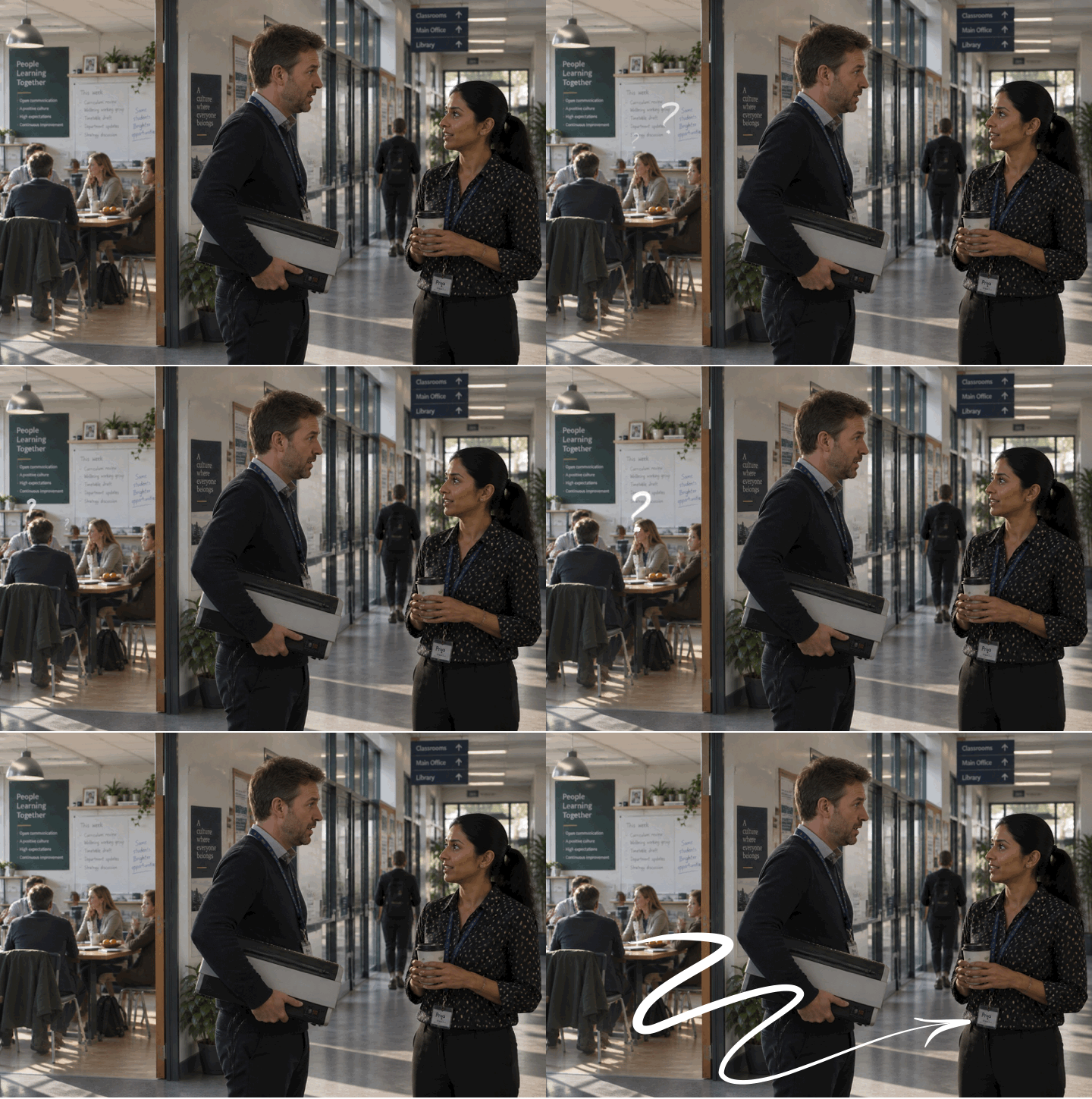
Sarah pushed open the staffroom door with her shoulder, coffee in one hand and laptop bag slipping from the other.
“Morning.”
A few replies came back from around the room. James was at the table nearest the window, scrolling through something on his laptop while eating toast. Anna and Mark were arguing amiably about whether Year 9 had always been this exhausting or whether they were simply getting older.
It was an ordinary Monday morning. Sarah put her coffee down.
“Has anyone heard anything about Humanities?”
James looked up.
“What about it?”
She hesitated.
“I think they’re restructuring it.”
That stopped the conversation. Mark turned in his chair.
“What?”
“I don’t know. Maybe I’m putting two and two together.”
“Based on what?”
Sarah pulled out the chair opposite James but didn’t sit down.
“I was here late on Friday. Martin and Helen came out of the meeting room together. Helen had one of those staffing spreadsheets open and Martin was carrying a document. Staffing Model 2027 or something like that.”
James frowned.
“That could mean anything.”
“I know.”
Sarah finally sat.
“But they still haven’t advertised Dan’s job.”

At the far end of the table, Nadia was buttering a slice of toast and listening without looking up. She was a learning support assistant, two years into the job, and she had a habit of arriving early enough to hear things and leaving early enough not to be part of them.
Nobody said anything for a moment. Dan had left at the end of June. His resignation hadn’t been particularly surprising; his wife had already moved back to the UK. What had been surprising was that, three weeks into September, his position still hadn’t appeared on the recruitment page.
Anna looked across the table.
“Maybe they’re just waiting.”
“Maybe.”
Sarah took the lid off her coffee.
“And on Thursday Martin asked me how many students we’d got choosing History next year.”
James stopped chewing.
“Did he say why?”
“No.”
There was another short silence. Then Mark leaned back.
“So what exactly have you heard?”
Sarah shook her head.
“Nothing. That’s the point. Nobody’s said anything.”
Behind her, pinned to the staffroom wall, was the school’s strategic plan. It had been professionally designed: four priorities, each accompanied by a photograph of students and a short statement.
OPEN COMMUNICATION
We build trust through clarity, dialogue and transparency.
A POSITIVE CULTURE
People flourish when they feel valued, informed and involved.
Nobody looked at it. Anna closed her laptop.
“You should ask Martin.”
“I probably will.”
But Sarah didn’t sound convinced. The door opened.
James glanced over. It was David from Science, looking for the laminator.
“Morning. What’s everyone looking so serious about?”
“Nothing,” Sarah said.
Mark laughed.
“Apparently Humanities is being restructured.”
Sarah looked at him.
“I didn’t say that.”
“You literally just did.”
“No. I said I think they might be looking at it.”
David stopped beside the cupboard.
“Why?”
James answered before Sarah could.
“They’ve not replaced Dan, and apparently Martin’s been asking about numbers.”
“And there was a staffing document,” Anna added. Sarah looked around the table.
“Can we not turn this into something it isn’t? I don’t actually know anything.”
David found the laminator.
“Sure.”
He tucked it under his arm.
“But it wouldn’t surprise me.”
The bell sounded in the corridor. Chairs moved. Laptops disappeared into bags. Coffee cups were abandoned beside the sink.
Within thirty seconds, the room was almost empty. Sarah stayed behind for a moment, looking at her timetable on her phone. Through the open door she could see David walking towards Science. He passed Priya halfway down the corridor. They stopped.
Sarah couldn’t hear what was said. She saw Priya turn towards him. Then she saw her look back towards the staffroom. David continued down the corridor. Priya stood still for a second. Then she changed direction. She wasn’t heading towards Science anymore. By 8:12, the story had left the room. And it no longer belonged entirely to Sarah.
Scene 2 - Monday, 8:13
Priya caught up with David outside the science prep room.
“Wait. What did you just say?”
David shifted the laminator under his arm.
“About Humanities?”
“Yes.”
He glanced back down the corridor.
“Sarah thinks they’re restructuring.”
Priya’s expression changed.
“Restructuring?”
“Well, looking at it. Apparently.”
“Who told Sarah?”
“I don’t know. She saw some staffing document. And they’re not replacing Dan.”
Priya stared at him.
“What staffing document?”
“No idea. Something for next year.”
A group of Year 8 students came around the corner and squeezed between them.
“Morning, Ms Patel.”
“Morning.”
Priya waited until they’d passed.
“And who is ‘they’?”
David shrugged.
“Martin. Helen. Leadership. I don’t know.”
The warning bell sounded. David lifted the laminator slightly.
“I’ve got Year 10.”
“Right.”
“Sarah said she doesn’t actually know anything.”
Priya gave a small laugh.
“Of course.”
David looked at her.
“What does that mean?”
“Nothing.”
But she didn’t move. David started towards his classroom, then turned.
“You know something?”
Priya shook her head.
“No.”
A pause.
“Just… we’ve done this before.”
Three years earlier, the school had been facing what leadership called a temporary adjustment in enrolment. Priya remembered the phrase because it had appeared everywhere. At the staff meeting. In the Head’s weekly email. On a slide showing five years of admissions data. There was no cause for alarm. Leadership was reviewing staffing levels as part of normal annual planning. No decisions had been made. Priya had believed them. Then the timetable changed. Two classes were combined. A colleague who had been expecting his contract to be renewed was told in May that it wouldn’t be. Another was offered reduced hours. None of it had technically contradicted what staff had been told. At the time the reassurance was given, no decisions had been made. Priya understood that.
What stayed with her was something else. By the time staff knew enough to understand what was happening, the decisions felt inevitable. She had been standing at almost exactly the same spot when Rachel told her. Priya could still picture it. Rachel had come out of the Deputy Head’s office holding a white envelope.
“Apparently my position isn’t needed next year.”
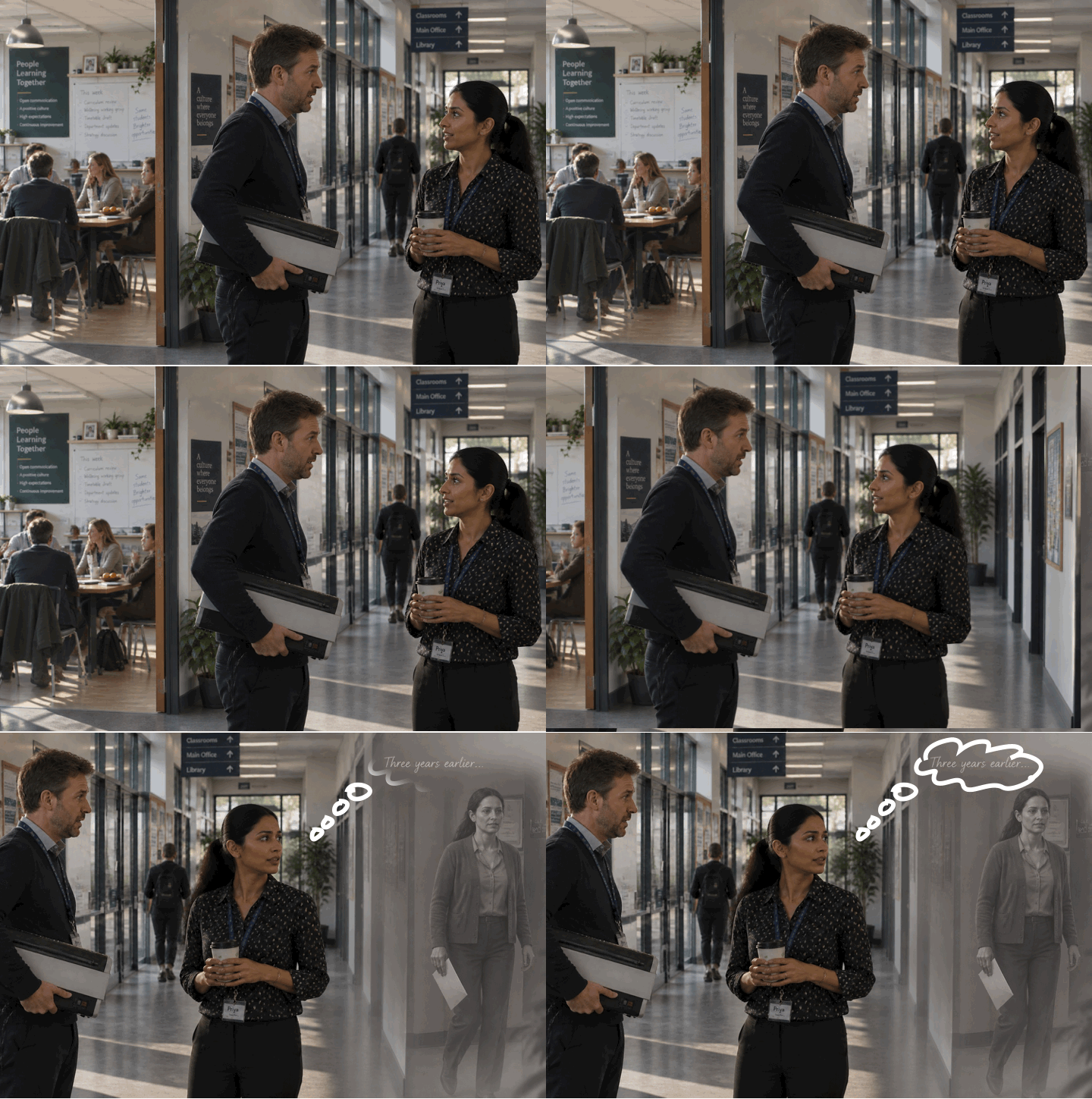
She had smiled when she said it. Not because it was funny. Priya had not known what to say. A week earlier they had been sitting together in a staff meeting while the Head spoke about protecting the school’s greatest asset: its people.
“Priya?”
She looked up.
Tom was standing beside her.
“Sorry?”
“You all right?”
“Yes. Fine.”
Tom was new. He had joined in August as Head of Mathematics and still possessed the slightly disorienting habit of looking directly at people when he asked them a question.
Priya picked up her bag. Nadia went past them with a tray of resources, head down, in a hurry.
“Nadia.”
She stopped.
“Have you heard anything about Humanities?”
“No.”
“They might be restructuring.”
Nadia glanced towards the corridor, then at Tom, then at the floor.
“It’s probably nothing.”
“That isn’t what I asked.”
She shifted the tray.
“I don’t know anything. I wouldn’t know anything.”
Priya waited, and something in the way she waited made Nadia want to say more, and something in the way Tom was watching made her not want to.
“I’ve got to get these to Room 12.”
She went.
Tom frowned.
“Who said that?”
“Sarah.”
“What did Martin say?”
“Nothing. Nobody has asked Martin.”
Tom waited.
“So nobody knows?”
“Not officially.”
He smiled.
“Then why doesn’t someone just ask him?”
Priya looked at him. For a moment she considered explaining. Instead, she adjusted the strap of her bag.
“You haven’t been here very long.”
Tom’s smile disappeared.
“What does that mean?”
“Nothing.”
She started walking.
“Just give it time.”
Tom watched her disappear around the corner. On the wall opposite him was one of the school’s culture posters.
SPEAK OPENLY. LISTEN CAREFULLY.
Trust grows when we have the conversations that matter.
Tom looked at it. Then down the corridor towards Martin’s office. The door was open. He checked his watch. 8:17.
He had thirteen minutes before registration. Tom started walking.
David had told Priya that Sarah thought Humanities was being restructured. Priya had told Tom that they might be restructuring. Neither had added very much. But something had changed anyway. Sarah had seen a document. David had heard a possibility. Priya had remembered a pattern. And Tom was about to ask a question about something that, ten minutes earlier, he hadn’t known existed.
Scene 3 - Monday, 8:19
Martin’s door was open.
Tom knocked anyway.
“Got a minute?”
Martin looked up from his screen.
“About twelve seconds.”
“Plenty.”
Martin smiled and pointed at the chair opposite him. Tom stayed standing.
“Are we restructuring Humanities?”
Martin’s smile disappeared.
“What?”
“Humanities. People are saying there’s a restructure coming.”
Martin stared at him.
“Who is saying that?”
“I don’t know.”
“You just said people are saying it.”
“I’ve heard it from one person. Who heard it from someone else.”
“Who?”
Tom hesitated.
It suddenly felt different when there was a name attached.
“Does it matter?”
“Yes.”
Martin pushed his chair back.
“Because there is no restructure.”
“Okay.”
“And I’d quite like to know why people think there is.”
Tom glanced at the clock. 8:20.
“Dan hasn’t been replaced. You’ve apparently been asking about History numbers. Someone saw a staffing document on Friday.”
Martin’s eyes narrowed slightly.
“What staffing document?”
“Something called Staffing Model 2027.”
For the first time, Martin didn’t answer immediately. Tom noticed.
Martin noticed Tom noticing.
“Right.”
He closed his laptop.
“There is no restructuring decision.”
Tom waited.
“That wasn’t quite what I asked.”
Martin looked at him.
“You asked if we were restructuring Humanities.”
“Yes.”
“And we’re not.”
“Are you looking at restructuring Humanities?”
Martin leaned back.
“We look at staffing every year.”
“So yes?”
“No. So we look at staffing every year.”
Tom smiled slightly.
“That’s a very Head-of-School answer.”
“And that’s a very new-Head-of-Maths question.”
Neither of them spoke for a moment. Then Martin sighed.
“Student numbers are softer than forecast. Helen and I are modelling what different enrolment scenarios would mean for staffing next year.”
“Across the school?”
“Yes.”
“Including Humanities?”
“Including every department.”
“Do staff know?”
“They know enrolment is below forecast.”
“That wasn’t my question.”
Martin stood.
“Tom, we model scenarios all the time. Most of them never happen. That’s what planning is.”
“I understand.”
“If I announce every scenario we model, people start worrying about decisions that haven’t been made.”
“I understand that too.”
“Then what are we arguing about?”
“We’re not.”
Tom looked towards the open doorway.
“We’re standing in different places.”
Martin frowned.
Tom continued.
“You know you’re modelling a hypothetical.”
“Yes.”
“They know Dan hasn’t been replaced.”
Martin said nothing.
“They know you’ve asked about option numbers. Someone has seen a staffing document. They know enrolment is down.”
“All of which have perfectly ordinary explanations.”
“Yes.”
“But?”
“But they don’t have the explanations.”
Martin glanced at his watch. 8:23.
“I have a meeting.”
“And I have registration.”
Tom turned to leave.
“Tom.”
He stopped.
“I need you not to feed this.”
Tom turned back.
“I’m not planning to.”
“There is no decision. Nothing has been decided. I’d rather we didn’t create anxiety over something that may never happen.”
“Fair enough.”
“And if you hear anything else, send people to me.”
“I will.”
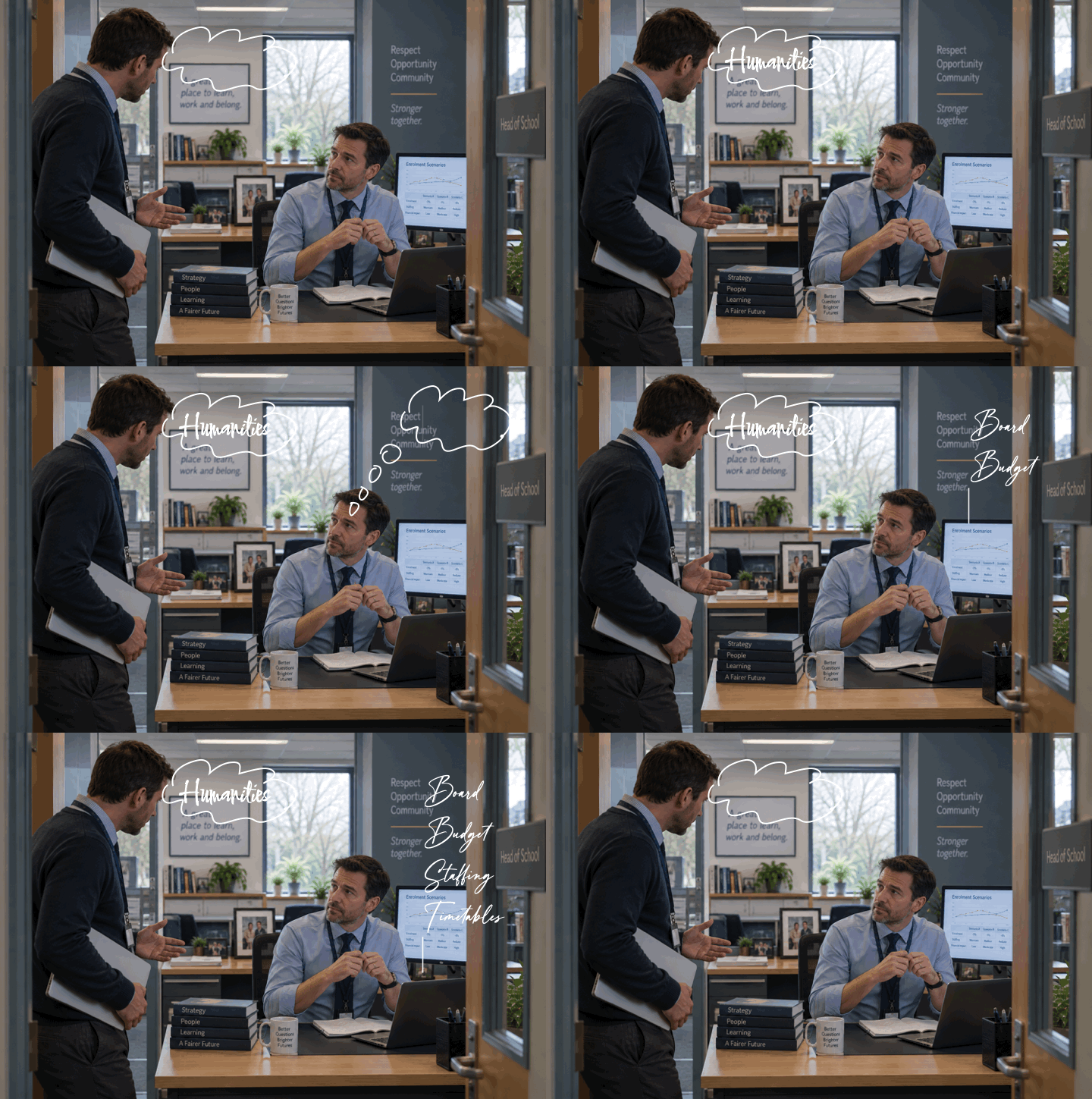
Tom stepped into the corridor. Nadia was at the end of it, waiting by the resources cupboard, and she had clearly been waiting long enough to have heard the door. She looked at him, and then away, and then at the noticeboard. Tom started towards her. She picked up a box and went into the classroom.
He stood for a moment in the empty corridor, and understood that he had just been able to do something she could not, and that the difference had nothing to do with either of them. Then Martin added:
“And tell whoever told you that they need to be more careful about repeating things they don’t know are true.”
Tom looked back at him. For a second, Priya’s words returned to him.
You haven’t been here very long.
“Okay.”
He left.
Martin closed the door. He stood for a moment with his hand still on the handle. Then he picked up his phone. Helen answered on the third ring.
“Morning.”
“Have you got a minute?”
“Barely.”
“There’s a rumour going around that we’re restructuring Humanities.”
Silence.
Then:
“How?”
“No idea.”
“Who started it?”
“I’m trying to find out.”
Another pause.
“Well, it’s not true.”
“I know.”
“We haven’t even finished the modelling.”
“I know.”
“And Humanities isn’t particularly exposed anyway.”
Martin looked through the glass panel in his door. Tom was halfway down the corridor.
“I know.”
“So?”
Martin sat down.
“People have seen enough pieces to put something together.”
Helen sighed.
“Then we need to shut it down before it gets out of hand.”
Martin didn’t answer.
“Martin?”
“Yes.”
“I’ve got Finance in two minutes. Can we talk at ten?”
“Fine.”
“And don’t say anything about the modelling yet.”
“I wasn’t going to.”
“Good.”
The call ended.
At 8:27, Martin opened his laptop again. His inbox showed forty-three unread messages. At the top was one from the Chair of the Board.
CONFIDENTIAL - 2027 ENROLMENT SCENARIOS
Martin opened it.
Following Thursday’s discussion, the Board would like leadership to model the financial implications of a further 8% reduction in enrolment before the October meeting.
Below that:
At this stage these should remain working scenarios. We do not want hypothetical staffing implications circulating before we understand whether any intervention is required.
Martin read it twice. Then he reopened the spreadsheet Helen had sent on Friday. Three tabs.
Scenario A - Current forecast
Scenario B - Additional 4% decline
Scenario C - Additional 8% decline
He clicked Scenario C. Several cells were highlighted. Humanities was not one of them. Martin closed the file. There was no Humanities restructure. There wasn’t even a proposal for one. He looked at the strategic plan mounted on the wall opposite his desk.
OPEN COMMUNICATION
We build trust through clarity, dialogue and transparency.
Martin had chosen the wording himself. His phone buzzed.
A message from Helen.
Please make sure nobody starts speculating about redundancies.
Martin typed:
Agreed.
Already spreading.
Let’s talk at 10.
Two replies he wrote and deleted. One he sent.
At 8:29, the registration bell rang. Across the school, classroom doors closed. For the next twenty minutes, almost everyone was in the place the timetable said they should be. The corridors fell silent. The story did not. In one room, Sarah was now wondering whether she should have said anything. In another, Priya was wondering whether she had been right three years ago to believe what she had been told. Tom was wondering why a school that encouraged people to speak openly needed him not to “feed” a question. And Martin was wondering how to correct a story without revealing the information that had allowed the story to begin. They were all responding to the same situation. None of them was responding to quite the same reality.
Scene 4 - Monday, 10:06
Helen arrived at Martin’s office carrying her laptop and two coffees.
She put one in front of him.
“Peace offering.”
“For what?”
“I don’t know yet.”
Martin moved a pile of papers from the chair. Helen sat.
“So. Humanities.”
“Apparently.”
“Who started it?”
“Does that matter?”
Helen looked at him.
“You asked me exactly the same thing on the phone.”
“I know.”
“And?”
“I’ve been thinking about it.”
“That sounds dangerous.”
Martin ignored her.
“Tom heard it from Priya. Priya heard it from David. David was in the staffroom with Sarah.”
“So Sarah.”
“Probably.”
Helen opened her laptop.
“I’ll speak to her.”
Martin shook his head.
“Not yet.”
“Why?”
“Because I don’t know what I’m speaking to her about.”
“She repeated confidential staffing information.”
“No. She saw us carrying a document.”
“She shouldn’t have seen it.”
“That isn’t the same thing.”
Helen stopped typing.
“Fine. She saw something she didn’t understand and started a rumour.”
“Maybe.”
“Martin.”
He turned his screen towards her.
“Look.”
The email from the Chair was still open. Helen read it.
“I’ve seen this.”
“I know. Read the second paragraph.”
She did.
We do not want hypothetical staffing implications circulating before we understand whether any intervention is required.
“Yes?”
“We’re doing exactly what the Board asked us to do.”
“Correct.”
“And exactly what I’d expect us to do.”
“Also correct.”
Martin leaned back.
“So what should we have communicated?”
Helen thought for a moment.
“That we’re reviewing enrolment.”
“We have.”
“That staffing is reviewed annually.”
“We’ve said that too.”
“That no decisions have been made.”
“No decisions have been made.”
“Then we’ve communicated accurately.”
Martin nodded.
“Yes.”
Helen waited.
“But?”
“I don’t know.”
She closed the laptop slightly.
“You’re bothered by this.”
“I’m bothered that something can be completely accurate and still not work.”
At 10:11, there was a knock on the glass. Anna stood outside.
Martin gestured her in.
“Sorry,” she said. “Two seconds.”
She looked at Helen, then Martin.
“Do either of you know if Sarah’s around?”
“Teaching,” Martin said. “Why?”
Anna hesitated.
“Nothing urgent.”
She turned to leave.
“Anna.”
She stopped.
Martin knew immediately he’d made a mistake. Not because he’d said anything wrong. Because Anna now knew he wanted to know.
“What?”
“Is everything okay?”
“Yes.”
Another hesitation.
“It’s just that she’s a bit upset.”
Helen looked up.
“About?”
Anna glanced between them.
“I’m not sure I should say.”
Martin almost laughed.
Ten minutes earlier he’d been trying to work out how confidential information had escaped into the school. Now somebody was standing in his office refusing to give him information because it wasn’t hers to share. “Fair enough,” he said. Anna nodded.
She reached the door. Then turned.
“Actually, you probably should know.”
Martin waited.
“She thinks she’s caused all this.”
“All what?”
“The redundancies thing.”
Helen sat forward.
“What redundancies thing?”
Anna’s face changed.
“Oh.”
Martin felt something sink.
“Anna. What exactly have you heard?”
“That three posts are going.”
“Where did you hear that?”
“I don’t know. Staffroom?”
“This morning?”
“No. Just now.”
Helen looked at Martin.
“There are no redundancies.”
“I didn’t think there were.”
“There aren’t.”
“Okay.”
“And there aren’t three posts going.”
“Fine.”
“Where did the number three come from?”
Anna shook her head.
“I genuinely don’t know.”
The silence stretched.
“Right,” Martin said. “Thank you.”
Anna opened the door.
“Should I tell people it’s not true?”
Helen answered immediately.
“Yes.”
Martin answered at the same time.
“No.”
Anna stopped.
The three of them looked at one another. Martin rubbed his forehead.
“Tell them no decision has been made.”
Helen frowned.
“But that sounds as though there might be redundancies.”
“There might be.”
“Not three.”
“No.”
“Not necessarily any.”
“No.”
Anna was still standing in the doorway.
“What exactly would you like me to say?”
Neither answered immediately.
She gave a small nod.
“That’s kind of the problem, isn’t it?”
And left.
At 10:17, Helen closed the office door.
“Okay. We need to get ahead of this.”
“How?”
“Staff email.”
“Saying?”
“That rumours about redundancies are inaccurate.”
“They are inaccurate.”
“Good.”
“But we are modelling staffing reductions.”
Helen stared at him.
“We are modelling scenarios.”
“One of which contains staffing reductions.”
“One of which contains everything we would have to consider if enrolment dropped another eight percent.”
“So if we say there are no staffing reductions being considered - ”
“I didn’t say that.”
“- we’re playing with language.”
Helen pushed her chair back.
“What do you want to do? Send everyone Scenario C?”
“No.”
“Tell them the Board asked us to model an eight percent decline?”
“No.”
“Tell them their jobs might be affected by a financial scenario that we don’t currently expect to happen?”
“No.”
“Then we need to say nothing.”
Martin looked at her.
“That doesn’t appear to be working either.”
At the other end of the corridor, Sarah was sitting in an empty classroom. Her Year 11 class had left five minutes earlier. Her phone lay face down on the desk. She turned it over. Three messages.
The first was from Anna.
The second was from Mark.
The third was from Priya.
You okay?
MarkApparently it’s 3 posts now. Any idea where that came from?
PriyaCan I talk to you?
10:14, three messages
Sarah stared at the screen. Then typed to Mark.
THERE ARE NO THREE POSTS. I never said that.
MarkI know. Just telling you what’s going round.
Sarah put the phone down. She felt angry now. Not with Martin.
Not with leadership.
With everyone.
She had said she didn’t know. She had specifically told them not to turn it into something it wasn’t. And somehow she was now responsible for three imaginary redundancies. Her phone buzzed again. Priya.
Sarah?
Sarah stood.
She was going to find her. Priya was outside the library talking to James. Sarah saw them before they saw her.
“Priya.”
Both turned.
“Can I speak to you?”
James immediately took the hint.
“I’ll leave you two.”
“No,” Sarah said. “Actually, stay.”
James stopped.
Sarah held up her phone.
“Where has this thing about three redundancies come from?”
Priya frowned.
“What three redundancies?”
“Exactly.”
“I haven’t heard that.”
“Well, apparently everyone else has.”
James looked uncomfortable.
“I heard something about posts.”
“From who?”
“I don’t remember.”
“You don’t remember?”
“Sarah, people talk.”
“Yes. Apparently.”
Priya folded her arms.
“What did you actually see on Friday?”
Sarah looked at her.
“I already told you.”
“No, you told David.”
“I didn’t tell David anything. He was in the room.”
“Fine. What did you tell everyone?”
Sarah exhaled.
“Martin and Helen came out of the meeting room. Helen had a staffing spreadsheet. Martin had a document called Staffing Model 2027. They’ve not replaced Dan. Martin asked me about History numbers.”
“And?”
“And what?”
“What else?”
“Nothing.”
Priya studied her.
“Did you ask Martin?”
“No.”
“Why not?”
Sarah laughed.
It was sharper than she’d intended.
“You’re asking me that?”
“Yes.”
“You just told Tom this morning that he hadn’t been here long enough to understand how things work.”
Priya’s expression changed.
“How do you know that?”
“Tom asked me what I’d heard.”
James looked from one to the other. Sarah continued.
“So which is it? Should I ask Martin, or should I know better than to ask Martin?”
“I didn’t say you shouldn’t ask him.”
“You implied it.”
“I said there’s history.”
“Yes. There is always history.”
Priya went quiet.
Sarah lowered her voice.
“And that’s exactly the problem.”
Behind them, students were moving between lessons. A Year 7 boy stopped to pick up a folder he’d dropped. Papers scattered across the corridor. Two older students crouched to help him.
On the wall above them was another of the school’s culture statements.
ASSUME POSITIVE INTENT
Strong communities begin with trust.
Sarah noticed it.
This time, she almost laughed. Priya followed her eyes.
“Don’t.”
“I didn’t say anything.”
“You didn’t have to.”
For a moment neither spoke. Then Priya said:
“Three years ago, they told us nothing was happening.”
Sarah’s expression softened.
“They said no decisions had been made.”
“Same difference.”
“No. It isn’t.”
“It felt like it.”
Sarah looked at her. There it was.
Not an argument about facts. Something harder.
“You still don’t trust them.”
Priya’s face tightened.
“I didn’t say that.”
“No.”
Sarah looked at the poster again.
“You didn’t have to.”
At 10:24, Martin’s inbox chimed. An email from a parent.
Subject: Staffing changes
He opened it.
Dear Martin, I hope you don’t mind me contacting you directly. I’ve just heard there may be significant staffing changes in Humanities next year. As Maya is due to begin her examination courses, I wanted to ask whether History will still be offered…
Martin stopped reading.
He turned his laptop towards Helen. She read the first two lines. Neither spoke.
Then Helen said:
“How did a parent hear?”
Martin looked through the glass wall of his office. Teachers moved along the corridor. Students passed between lessons. Somewhere, a phone buzzed. He looked back at the email. At 8:07, Sarah had said:
“I think they’re restructuring Humanities.”
At 10:24, a parent wanted to know whether the school was cancelling History. The story had travelled less than fifty metres. It had crossed the staffroom, three corridors, at least six people and, somehow, the boundary of the school itself. And with every person it passed, it had picked up something new. Not necessarily a lie. A memory.
An assumption.
A fear.
A missing piece.
A reasonable inference.
By now, finding out who had started the rumour would tell Martin almost nothing about why it had become believable.
Scene 5 - Monday, 10:31
Martin read the parent’s email again.
Then he forwarded it to Helen without comment.
“I’m sitting beside you.”
“I know.”
Helen’s laptop chimed.
She opened it.
“You realise what happens next.”
“Yes.”
“She asks another parent.”
“Yes.”
“They ask their children.”
“Yes.”
“The children ask their teachers.”
“Yes.”
“And by lunch we’ll be denying something nobody was proposing in the first place.”
Martin looked at her.
“Can you deny it?”
“Cancelling History? Yes.”
“Redundancies?”
Helen didn’t answer.
Martin turned back to his screen.
“Exactly.”
There was a knock. This time the door opened before either of them responded. Leila, the Head’s assistant, stood there holding her phone.
“Sorry. You need to see this.”
She put the phone on Martin’s desk. It was a screenshot from the Year 10 parent WhatsApp group.
Does anyone know what’s happening with Humanities? Maya says some teachers may be leaving and History might not run next year.
Does anyone know if this is confirmed?
Our daughter heard the same thing.
I’ve been worried about staff turnover for a while.
Does this explain why Dan hasn’t been replaced?
The school needs to be transparent about this. We shouldn’t have to find things out through the children.
Eleven replies. Most of them were questions.
Martin handed the phone back.
“How did Maya hear?”
“No idea.”
“Can we find out?”
Leila raised an eyebrow.
“I could interrogate Year 10.”
“Point taken.”
She left.
Tom was in the doorway with a set of exercise books he had clearly stopped carrying some time ago.
“Sorry. I heard the end of that.”
“Come in.”
He didn’t.
“One of my Year 10s asked me this morning whether she should still pick History.”
Martin waited.
“She said her mum had seen it on the group. Then she said - and I don’t think she was being clever - ‘so is it true, or is it one of those things you lot say?’”
“What did you tell her?”
“That History was running. She asked me if I was sure.”
Helen put her pen down.
“What did you say to that?”
Tom looked at her.
“I said yes. And then I stood in a corridor wondering whether I was allowed to.”
He went.
Helen was already typing.
“We need an email.”
Martin stood.
“I know.”
He walked to the window. Below, two classes were crossing the courtyard.
“What would you write?”
Helen read from her screen.
“Dear colleagues. We are aware that some speculation is circulating regarding possible staffing changes in Humanities. There are currently no plans to restructure the Humanities department or discontinue any subjects.”
“True.”
“As part of our normal annual planning, leadership regularly reviews enrolment, curriculum and staffing requirements.”
“True.”
“We would ask colleagues not to circulate unverified information, as this can create unnecessary concern among staff, students and families.”
Martin turned around.
There it was.
A perfectly reasonable email. Every sentence true.
He imagined Sarah reading it. Then Priya.
Then Tom.
“What?” Helen asked.
“Nothing.”
“You’re doing the face.”
“What face?”
“The one where something technically correct has offended you.”
Martin sat down.
“Read the last sentence again.”
Helen did.
“What’s wrong with it?”
“Nothing.”
“Martin.”
“Send it.”
She looked at him.
“You don’t mean that.”
“No.”
Helen closed the laptop.
“Then tell me what you’re seeing.”
Martin thought for a moment.
“We’re asking staff not to circulate unverified information.”
“Yes.”
“While asking them to trust us about information we’re deliberately not giving them.”
Helen stared at him.
“That’s not fair.”
“No. It isn’t.”
“We have a responsibility not to create unnecessary anxiety.”
“I know.”
“We have confidential Board work.”
“I know.”
“We have no proposal. No decision. We don’t even have a recommendation.”
“I know.”
“So what exactly are we supposed to disclose?”
“I don’t know.”
Helen sat back.
“Then perhaps the problem isn’t communication.”
Martin looked at her.
“Perhaps people need to stop filling every silence with the worst possible explanation.”
Monday, 10:38
In the staffroom, Sarah’s coffee was still where she’d left it.
Cold now.
Mark was making another one when James walked in.
“Have you seen Sarah?”
“Not since break.”
James opened the fridge.
“Martin knows.”
Mark stopped.
“Knows what?”
“About the rumour.”
“How?”
“Tom asked him.”
Mark stared at him.
“Tom went straight to Martin?”
“Apparently.”
“Christ.”
“What?”
“Nothing.”
James took out a yoghurt.
“Why is everyone saying ‘nothing’ today when they obviously mean something?”
Mark lowered his voice.
“Sarah’s going to get hauled in.”
“For what?”
“For starting all this.”
“She didn’t start the redundancies thing.”
“No, but that’s not how it’ll look.”
James peeled the lid from the yoghurt.
“She literally said she didn’t know.”
“You think that matters?”
“Yes.”
Mark gave him a look.
“Okay.”
James put the yoghurt down.
“What?”
“You’ve been here what, eighteen months?”
“Two years.”
“Right.”
James stared at him.
“You’re doing the Priya thing.”
“What Priya thing?”
“Apparently nobody who hasn’t worked here for a decade is qualified to understand anything.”
Mark laughed.
“That’s not what I mean.”
“Then what do you mean?”
Mark leaned against the counter.
“Sarah challenged the timetable changes last year.”
“So?”
“She challenged the assessment policy before that.”
“Okay.”
“She and Martin don’t exactly see eye to eye.”
James frowned.
“I’ve seen them disagree. They seemed fine.”
“They are fine.”
“So what are you saying?”
Mark opened his mouth. Then stopped.
He wasn’t entirely sure. That Sarah was difficult? He didn’t think she was. That Martin held grudges? He didn’t think that either. That people who challenged leadership eventually paid for it? He couldn’t name anyone. Still, the thought felt familiar. “I don’t know,” he said. James smiled.
“There it is again.”
On the wall behind them:
WE VALUE PROFESSIONAL CHALLENGE
Different perspectives make our decisions stronger.
Neither man noticed it.
Monday, 10:46
Tom did.
He had come in for coffee and caught the end of the conversation. He stood beneath the poster while Mark explained what had happened.
“So now Sarah’s in trouble?”
“I didn’t say she’s in trouble.”
“You said she’ll get hauled in.”
“Figure of speech.”
“And why would she get hauled in?”
“Because she started the rumour.”
James interrupted.
“She didn’t.”
Mark sighed.
“Fine. She started the thing that became the rumour.”
Tom looked between them.
“Do either of you know that Martin intends to speak to her?”
“No.”
“Has anyone said she’s in trouble?”
“No.”
“Has Martin said anything at all?”
“No.”
Tom nodded.
“So we’ve now got a rumour about what leadership will do about the rumour.”
James laughed.
Mark didn’t.
Tom took a mug from the cupboard.
“This place is incredible.”
“You’ll learn,” Mark said. Tom stopped.
There it was again.
You’ll learn.
You haven’t been here long.
That’s how things work.
He poured his coffee.
“What exactly am I going to learn?”
Mark looked surprised.
“What?”
“You’ve said it twice now. Priya said basically the same thing this morning. What is it that everyone knows that I don’t?”
Mark shrugged.
“Nothing specific.”
“Then how do I learn it?”
“Work here long enough.”
Tom looked at James. James looked amused, but he didn’t answer.
“So there are rules,” Tom said, “but nobody can tell me what they are.”
“They’re not rules.”
“Expectations?”
“No.”
“Patterns?”
Mark considered that.
“Maybe.”
“What patterns?”
Mark looked towards the open door. His voice dropped automatically.
“That challenging things doesn’t always get you anywhere.”
“Why are you whispering?”
Mark stopped.
He hadn’t realised he was. Tom looked at him. Then at the poster.
WE VALUE PROFESSIONAL CHALLENGE
Different perspectives make our decisions stronger.
He pointed at it. Mark followed his finger. For a second nobody spoke. Then James laughed.
“Okay. That’s quite funny.”
Mark didn’t.
Monday, 10:52
Sarah was on her way to Martin’s office.
Not because she’d been summoned. Because she was angry. She had rehearsed what she was going to say twice.
I want to be absolutely clear about what I actually said.
No.
Too defensive.
I understand there’s a rumour circulating and my name seems to have become attached to it.
Too formal.
By the time she reached the office she had settled on:
Can we talk?
Martin’s door was closed. She raised her hand to knock. Through the glass, she could see him talking to Helen. Helen’s laptop was open between them. Sarah couldn’t see the screen. Martin said something.
Helen shook her head. Then both looked towards the door. Towards Sarah.
Helen reached forward and closed the laptop. It was instinctive.
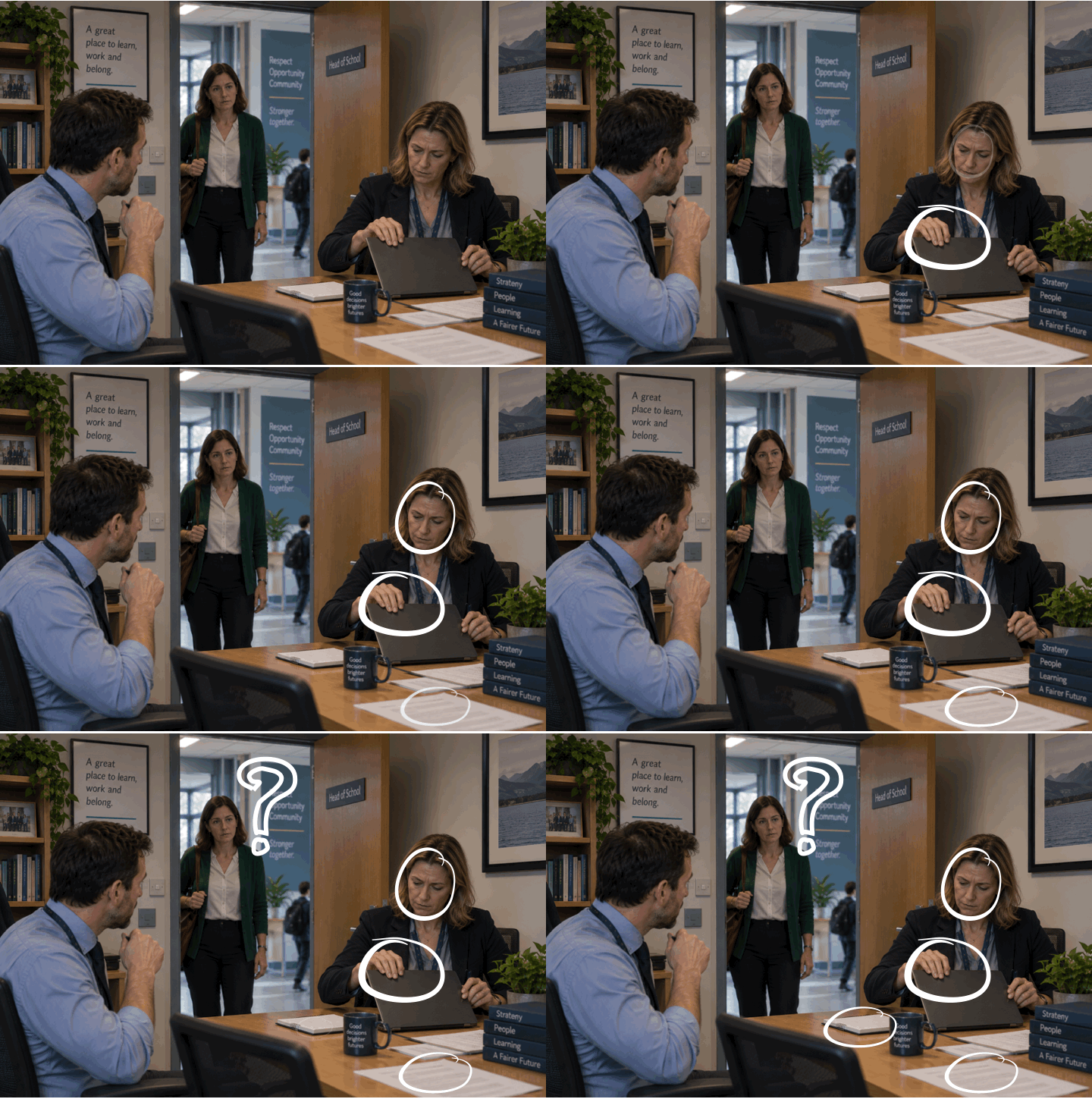
Completely ordinary.
There was confidential information on the screen and someone was standing outside. Sarah knew that.
She knew it as clearly as Martin knew there was no Humanities restructure. She lowered her hand. Martin stood and opened the door.
“Sarah.”
“Sorry. You’re busy.”
“It’s fine. Come in.”
“No, honestly. Later.”
“Sarah - ”
“I’ve got a class.”
She didn’t.
Martin knew she didn’t. Sarah knew Martin knew she didn’t. Neither said so.
“Okay,” he said.
She walked away.
Martin watched her go. Then closed the door. Sarah reached the end of the corridor before taking out her phone. She opened her messages. Priya had written again.
You okay?
Yep.
Just went to see Martin. Helen was in there. They closed the laptop as soon as they saw me.
PriyaJesus.
It probably means nothing.
That’s exactly what happened last time.
One word deleted, one sentence sent, one more deleted before it could go.
Sarah stopped.
The sentence sat on the screen. She looked back down the corridor towards Martin’s office. Nothing had changed.
Martin and Helen were still modelling hypothetical scenarios. There was still no Humanities restructure. There were still no three redundancies. History was still running next year. And Sarah knew perfectly well that people closed laptops when someone approached confidential work. But the scene looked different now. Because Priya had given it a past. Sarah deleted the sentence she had been writing. She put the phone in her pocket. And walked away.
At 10:54, Martin and Helen closed a laptop. For Martin, it was confidentiality. For Helen, it was habit. For Sarah, it was probably nothing. For Priya, it was evidence. The act itself had lasted less than a second. Its meaning would last considerably longer.
Scene 6 - Monday, 12:14
By lunchtime, nobody was talking about Humanities.
They were talking about communication. Sarah noticed the change almost immediately. She entered the staffroom expecting the conversation to stop. It didn’t.
That was worse.
Mark was standing beside the microwave.
“You can’t announce things that haven’t happened.”
Priya was sitting at the table.
“Nobody said you should.”
“So what should Martin have announced?”
“I don’t know.”
“Exactly.”
Priya looked irritated.
“That doesn’t mean the alternative is saying nothing.”
“What alternative?”
“I don’t know, Mark.”
“So we’re angry that leadership didn’t communicate something we can’t say they should have communicated?”
Priya stared at him.
“Why are you making this about whether I’m angry?”
“Are you?”
“No.”
“You sound angry.”
“Maybe because you’re telling me what I think.”
James looked up from his lunch.
“This has gone well.”
Nobody laughed.
Sarah put her bag down.
“Can we stop?”
They turned.
“This is ridiculous.”
Priya shifted in her chair.
“Sarah - ”
“No. There is no restructure. There aren’t three redundancies. Nobody is cancelling History.”
Mark folded his arms.
“How do you know?”
Sarah stopped.
It was a perfectly reasonable question.
“I don’t.”
Mark raised his eyebrows.
“Right.”
“But neither does anyone else.”
“Also right.”
“So why are we still talking about it?”
Priya answered.
“Because something is happening.”
“We don’t know that.”
“Yes, we do.”
“How?”
“Dan hasn’t been replaced.”
Sarah sighed.
“We’ve done this.”
“Martin asked you about History numbers.”
“We’ve done that too.”
“There was a staffing document.”
“Yes.”
“Then something is happening.”
Sarah pulled out a chair.
“Something is always happening.”
Priya shook her head.
“You know what I mean.”
“No, actually. I don’t.”
She sat.
“Maybe they’re modelling next year’s timetable. Maybe they’re looking at enrolment. Maybe they’re changing allocations. Maybe Helen likes spreadsheets. We have taken four completely ordinary things and built a story out of them.”
Priya looked at her.
“You built the story.”
The room went quiet.
Sarah stared at her.
“Excuse me?”
“You were the one who said restructure.”
“I said I thought they might be restructuring.”
“Exactly.”
“No. Not exactly.”
Sarah’s voice had risen.
“I also said I didn’t know. Repeatedly.”
Priya didn’t answer.
Sarah continued.
“And now apparently that’s irrelevant because everyone has decided what I meant.”
“I haven’t decided what you meant.”
“You just told me I started it.”
“You did.”
Sarah pushed her chair back.
“Fine.”
She stood.
“I shouldn’t have said anything.”
She picked up her bag. Mark stepped aside to let her pass. At the door she stopped.
“But here’s the interesting part.”
Nobody spoke.
“I don’t think any of you actually believed me.”
She looked around the room.
“You believed yourselves.”
Then she left.
Monday, 12:19
Nobody spoke for several seconds.
James eventually put down his fork.
“She has a point.”
Priya looked at him.
“Does she?”
“Yes.”
“She said restructure.”
“And you supplied three years ago.”
Priya’s expression hardened.
“I supplied something that actually happened.”
“I know.”
“So?”
“So maybe that’s what she’s saying.”
Priya pushed her plate away. James continued.
“David heard Sarah. You heard David. Tom heard you. Somewhere we got three jobs and cancelled History. Sarah didn’t do that.”
“I’m not blaming Sarah.”
“You literally just did.”
Priya looked towards the doorway. For the first time that morning, she seemed uncertain. Mark opened the microwave.
“What I want to know is where three came from.”
Nobody knew.
Monday, 12:21
The answer was sitting twelve metres away.
Claire Morgan, Head of English, was eating lunch at her desk. She had no idea anyone was looking for it. At 9:42 that morning, one of her teachers had stopped her outside the photocopy room.
“Have you heard they’re restructuring Humanities?”
Claire hadn’t.
But she had attended the middle-leaders meeting the previous Wednesday. Near the end, Helen had shown a slide on enrolment. Three departments were below the numbers used in the staffing forecast. Humanities was one.
English was another.
The third was Languages. Helen had said:
“This isn’t an action list. We’re simply asking everyone to check assumptions before we begin timetable planning.”
Claire remembered that clearly. She also remembered Martin adding:
“Please don’t turn three data points into three staffing decisions.”
Everyone had laughed.
Claire had forgotten the exchange almost immediately. Until 9:42 on Monday morning. When her colleague mentioned a Humanities restructure, the meeting returned to her. Three departments.
Three data points.
Three.
Claire had said:
“There were three areas they were looking at last week.”
Her colleague had heard:
“They’re looking at three areas.”
By morning break, someone else had asked whether that meant three departments were losing staff. By 10:00, three departments had become three posts. Claire knew none of this. She was answering emails. At 12:23 her phone buzzed. A message from Mark.
Random question. Did you hear anything about 3 posts?
No. Why?
There were 3 depts below forecast in the figures Helen showed MLs last week. But nothing about posts.
Claire typed a reply, thought about Wednesday, deleted it, and sent a different one.
Ah.
That might be it.
Might be what?
No response.
She put the phone down. Then picked it up again. Something bothered her.
Not the rumour.
The meeting.
Wednesday, 4:17 p.m.
Claire could see the slide again.
Three departments highlighted amber. Humanities.
English.
Languages.
Helen had talked about enrolment assumptions. Martin had explicitly said there were no staffing decisions. Then he had asked middle leaders to do something. What was it?
Claire searched her notes. She found Wednesday’s page.
Enrolment / timetable
Underneath: - check option numbers - staffing assumptions - speak to teams? - no decisions Claire stared at the third bullet.
Speak to teams?
Was that an instruction? A question she’d written to herself? Something Helen had said? She couldn’t remember.
She opened the middle-leaders Teams channel and scrolled back. There it was.
A message from Helen, sent Wednesday at 5:06.
Thanks everyone. As discussed, please give teams appropriate context around the enrolment figures where questions arise. Nothing here represents a staffing decision; we’re checking assumptions early so that we retain options later.
Claire read it twice.
Please give teams appropriate context.
She had not.
Not deliberately.
Nobody had asked.
And there had seemed little point worrying people about numbers that might change. Her reasoning had been almost identical to Martin’s. She closed Teams.
Then opened it again.
Monday, 12:28
Claire walked into the staffroom.
Sarah wasn’t there.
Priya, Mark and James were.
“Can I ask something?”
Mark looked up.
“Sure.”
“Has anyone actually spoken to their Head of Department about this?”
Priya shook her head. James said, “Tom spoke to Martin.”
“No. I mean before today.”
“About what?”
“The enrolment figures.”
Blank faces.
Claire pulled out a chair.
“Okay.”
Nadia was at the sink, rinsing a cup, and had been for some time.
“Sorry,” Mark said. “Do you know something?”
“No.”
“You’ve been standing there.”
“I work here.”
A pause.
“I mean - you’ve been listening.”
Nadia put the cup down.
“Everyone’s been listening. I’m just the one who isn’t allowed to have an opinion about it.”
Nobody answered that.
“Sorry,” she said. “Forget I said anything.”
“No,” Claire said. “Don’t.”
Mark looked at her.
“What?”
“We had them at middle leaders last Wednesday.”
Priya sat forward.
“What figures?”
“Forecast numbers for next year.”
“And?”
“Humanities was below forecast.”
Nobody spoke.
“So Sarah was right?”
“No.”
Claire said it too quickly.
“No. That’s exactly how this keeps happening.”
She opened her laptop.
“There were three departments below forecast. Leadership asked us to check assumptions.”
Mark looked at James.
“Three.”
Claire followed his expression.
“Oh, no.”
“What?”
“The three posts.”
Priya looked between them.
“What three posts?”
Mark almost laughed.
“Apparently we’ve found them.”
“No, you haven’t,” Claire said.
“There are three departments.”
“Yes.”
“Below forecast.”
“Yes.”
“And someone said three posts.”
“Yes.”
“So - ”
“No.”
Claire turned the laptop towards them.
“This is what we keep doing.”
On the screen was Helen’s message. Priya read it.
Please give teams appropriate context around the enrolment figures where questions arise.
She looked at Claire.
“Did you?”
“No.”
“Why not?”
Claire paused.
“Because there was nothing to tell you.”
Priya’s expression changed.
Claire heard it as soon as she’d said it. She tried again.
“I mean, there were no decisions.”
“But there was something.”
“Some numbers.”
“That affected us.”
“Potentially.”
“That leadership was discussing.”
“Yes.”
“That you knew about.”
Claire closed her eyes briefly.
“Yes.”
“And you decided there was nothing to tell us.”
“I didn’t decide that.”
“You literally just said - ”
“I forgot.”
Priya stopped.
Claire looked embarrassed.
“I wrote myself a note. I meant to mention it. Then Thursday happened and we had the moderation issue, and Friday I was off-site.”
She shrugged.
“Honestly? It went out of my head.”
That changed the room. There was no conspiracy. No instruction from Martin to keep staff uninformed. No deliberate withholding.
There was a Teams message. There was a middle leader. There was Thursday.
And there was forgetting. James leaned back.
“So leadership thought we’d been told.”
Claire shook her head.
“Not exactly.”
“But they told you to give context.”
“Yes.”
“And you didn’t.”
“Yes.”
“So they thought - ”
“I don’t know what they thought.”
Mark smiled faintly.
“Appropriate context.”
Claire looked at him.
“What?”
“It’s clever.”
“How?”
“Nobody actually owns it.”
Claire frowned.
Mark pointed at the screen.
“Leadership gives middle leaders ‘appropriate context’. Middle leaders decide what’s appropriate. Staff don’t know there’s context to ask for. Everyone has technically communicated.”
Nobody answered.
Priya was staring at the message.
“Say I’m new,” she said. “Say it’s my first term. What would I have learned this week about bringing something up?”
“That you should have asked Martin,” James said.
“And what would I have learned from finding out that I should have asked Martin?”
He didn’t answer.
“Don’t ask Martin unless you’re sure,” she said. “That’s the rule. Not the one on the wall. The one you learn by watching what happens to people who get it wrong.”
Monday, 12:34
Tom entered.
He saw Claire’s laptop turned towards the group.
“What have I missed?”
James laughed.
“About six versions.”
Claire moved the laptop so he could see. Tom read Helen’s message. Then looked at Claire.
“Did your team know?”
“No.”
“Why not?”
“I forgot.”
Tom nodded.
“Fair enough.”
Claire looked surprised.
“That’s it?”
“What do you want me to say?”
“I don’t know. Everyone else looks like I’ve personally dismantled the communications strategy.”
Tom pulled out a chair.
“You forgot something.”
“Yes.”
“That happens.”
Priya looked at him.
“And that’s okay?”
“I didn’t say that.”
“So what are you saying?”
Tom thought.
“That if a communication process only works when every middle leader remembers to interpret ‘appropriate context’ in the same way, perhaps forgetting isn’t the most interesting part.”
Claire looked at him.
“Thank you. I think.”
Tom smiled.
“It wasn’t entirely a defence.”
Sarah appeared in the doorway. She had come back for the coffee she’d abandoned four hours earlier. She saw the group around Claire’s laptop.
“What now?”
James looked at her.
“We found the three.”
Sarah stared.
“The three what?”
“Not posts.”
“James.”
“Departments.”
Claire intervened.
“Can we start again?”
“No,” Sarah said.
Everyone stopped.
She walked to the table, picked up her cold coffee and dropped it into the bin.
“I think starting again might be how we got here.”
She turned to leave. Tom looked at her.
“Sarah.”
She stopped.
“Martin told me this morning that there is no Humanities restructure.”
Sarah said nothing.
“He also said they’re modelling enrolment scenarios across the school.”
Claire looked sharply at him.
“He told you that?”
“Yes.”
“And you didn’t tell anyone?”
Tom paused.
It was only a fraction of a second. But everyone saw it.
“No.”
Priya gave a short laugh. Tom turned to her.
“What?”
“Nothing.”
“No. Go on.”
“You spent this morning asking why people don’t just talk to each other.”
“Yes.”
“And then Martin told you what was actually happening.”
“Yes.”
“And you kept it to yourself.”
“He asked me not to feed speculation.”
“So you decided not to tell us.”
Tom opened his mouth. Then closed it.
For the first time that day, he understood exactly how Claire felt.
“I suppose I did.”
Nobody spoke.
Six people were now sitting around the same table. Sarah had seen a document and made an inference. Priya had attached a memory to it. Claire had received information and forgotten to pass it on. Tom had received different information and chosen not to pass it on. Mark had supplied a belief about what happened to people who challenged leadership. James had mostly asked questions. Each could explain what they had done. Most of the explanations were reasonable. On the wall behind them, the strategic plan remained exactly where it had been all morning.
OPEN COMMUNICATION
We build trust through clarity, dialogue and transparency.
This time, everyone noticed it. Nobody laughed.
Scene 7 - Monday, 12:41
The silence lasted until Mark’s phone vibrated against the table.
He glanced at it. Then again.
Three messages.
He turned the screen over. Tom noticed.
“More?”
“Parent.”
Everyone looked at him.
“Not a parent. My wife.”
Mark’s wife taught at the primary school across town. Their daughter, Ellie, was in Year 10.
“What does she want?” James asked. Mark read the message.
Ellie says History might not run next year. Is there something you haven’t told me?
Nobody spoke.
Then Sarah laughed.
Not because it was funny.
“Of course.”
Mark typed.
No. It’s nonsense.
Not sent.
He stopped before sending it. Sarah watched him.
“Is it?”
Mark looked up.
“What?”
“Is it nonsense?”
“Yes.”
“How do you know?”
“Because - ”
He stopped.
It was Sarah’s question from twenty minutes earlier, returned to him. Tom said, “Martin told me there is no Humanities restructure.”
“Fine.”
Mark changed the message.
There is no Humanities restructure.
He looked at it. Then at Tom.
“Can I say that?”
“Yes.”
“Definitely?”
“That’s what Martin told me.”
Mark pressed send.
Three seconds later:
Then why are staff telling students there is?
Mark put his phone face down.
“I’m going to lunch.”
“You are at lunch,” James said.
“Then I’m going somewhere else.”
He left.
Monday, 12:44
Sarah sat down again.
Nobody seemed particularly interested in eating anymore. Claire closed her laptop.
“Can I say something uncomfortable?”
Priya smiled.
“Why stop now?”
“I don’t think the problem is that we weren’t told.”
Sarah looked at her.
“Go on.”
Claire hesitated.
“I think we don’t know what counts as being told.”
Nobody interrupted.
“Leadership gave middle leaders the figures. They gave us context. They asked us to use judgement with our teams.”
“And you forgot,” Priya said.
“Yes.”
Claire didn’t defend herself.
“But suppose I hadn’t. What exactly would I have said?”
She looked around the table.
“‘Humanities is below forecast, but don’t worry because nothing has been decided’?”
“That would have been useful,” Priya said.
“Would it?”
“Yes.”
“Or would we have been having this conversation last Thursday instead?”
Priya didn’t answer.
Claire continued.
“If I’d said leadership was modelling staffing, someone would have asked what that meant. I wouldn’t have known. Someone would have asked whether jobs were at risk. I wouldn’t have known. Someone would have asked which departments. I knew that, but apparently saying three departments is enough to create three redundancies.”
James smiled.
“Fair.”
“So maybe I ask leadership for more information.”
She looked at Tom.
“And they can’t give it to me because the Board discussion is confidential.”
Tom nodded.
“So I tell you there’s something I can’t tell you.”
Sarah leaned back.
“Which would go brilliantly.”
“Exactly.”
Priya looked from one to the other.
“So what’s the answer? Say nothing?”
“No.”
“Tell us everything?”
“No.”
“Then what?”
Claire shook her head.
“I don’t know.”
There it was again. The phrase that had appeared all morning. Not knowing.
Sarah had not known what the document meant. David had not known who “they” were. Priya had not known whether the past was repeating. Tom had not known why people wouldn’t ask. Martin had not known what he could say. Claire had not known what context was appropriate. And none of that had prevented anyone from acting.
Monday, 12:49
Martin was still in his office when Leila appeared again.
This time she didn’t knock.
“The Chair.”
“What about him?”
“On line one.”
Martin looked at Helen. Helen closed her eyes.
“Of course he is.”
Martin picked up.
“Peter.”
“Martin. Sorry to bother you.”
“No problem.”
“I’ve just had a slightly odd call.”
Martin already knew.
“Parent?”
“Governor.”
That was worse.
“One of the parent governors has been asked whether the Board has approved staffing reductions.”
Martin looked at Helen.
“No.”
“I assumed not.”
“We haven’t even discussed reductions.”
“Well, technically we have.”
“We’ve discussed scenarios.”
“Yes. That’s what I told him.”
Martin rubbed his forehead.
“Peter, there is a rumour circulating about Humanities.”
“Based on?”
“Several things.”
“Such as?”
Martin looked at the spreadsheet on his screen.
“Us modelling staffing.”
A pause.
“Well, yes.”
“Dan’s vacancy.”
“Yes.”
“Lower enrolment.”
“Yes.”
“Me asking about History numbers.”
Another pause.
“I see.”
“And somebody saw the staffing document.”
“Ah.”
“Exactly.”
Peter was quiet for a moment.
“Still quite a leap to redundancies.”
“Yes.”
“And cancelling History?”
“Yes.”
“Where did that come from?”
“No idea.”
Martin looked through the glass. A group of students were walking past his office. One waved.
He waved back.
“I’m trying to work that out.”
Peter sighed.
“Do we need to put something out?”
“Helen and I have been discussing that.”
“And?”
“We don’t know what to say.”
The silence on the other end was different this time. Martin realised how unusual the sentence sounded coming from him. Peter said, “That’s not very reassuring.”
“No.”
“What do staff need to know?”
“I think that’s the question.”
“Well, surely they need to know there’s no decision.”
“They know that now.”
“And?”
“It doesn’t seem to be enough.”
Peter paused.
“Why not?”
Martin looked again at the strategic plan on his wall.
“I’ll tell you when I know.”
Monday, 12:55
Peter ended the call and remained at his desk.
He was not at school. He was twenty kilometres away, in an office above an architectural practice, looking at exactly the same enrolment figures Martin had open. He clicked through the Board papers from Thursday. The discussion had been routine. At least, it had felt routine. Applications were down.
Not dramatically.
Enough to warrant attention. The Finance Committee had asked what another four or eight percent decline would mean. Helen had said she could model it. Peter had said:
“Let’s understand the exposure before we frighten anybody.”
Nobody had disagreed.
He still thought it had been the right decision. He opened his notes. Beside the enrolment item he had written:
No surprises.
Peter stared at the words. It was one of his rules as Chair. No surprises between Board and Head. No surprises for governors. No surprises for the community where they could reasonably be avoided. He had always thought of it as a principle of good communication. Now he wondered whose surprise counted.
Monday, 1:03
Martin left his office.
He had intended to find Sarah. Instead, halfway down the corridor, he saw six people through the open staffroom door. Sarah.
Priya.
Tom.
Claire.
James.
Anna had joined them. Nobody was arguing.
That somehow made him more nervous. He stepped inside.
Conversation stopped.
There it was.
The thing people always insisted happened when leaders entered staffrooms. Martin had never been sure whether it was true. Now he knew.
“Afternoon.”
A few replies.
He looked at Sarah.
“Have you got a minute?”
Every eye in the room moved towards her. Sarah noticed.
So did Martin.
He immediately understood what the room thought was happening. “No,” Sarah said.
Martin was surprised.
She stood.
“I mean, yes. But can we do it here?”
Martin glanced around.
“If you prefer.”
“I do.”
“All right.”
Sarah folded her arms.
“I assume this is about this morning.”
“Yes.”
“I want to be clear. I said I thought Humanities might be being restructured. I said I didn’t know. I did not say anyone was being made redundant. I did not say History was being cancelled.”
“I know.”
Sarah blinked.
“You do?”
“Yes.”
“How?”
“Because I’ve spent most of the morning tracing it backwards.”
James smiled faintly.
“Any luck?”
Martin looked at him.
“Not really.”
That surprised them.
Martin pulled out a chair. He didn’t sit behind the table. He sat among them.
“Can someone tell me where the three posts came from?”
Claire raised her hand slightly.
“I think that might be me.”
Martin looked at her. Claire explained.
The middle-leaders meeting.
The three departments.
The conversation at the photocopier. Her forgotten note.
Martin listened without interrupting. When she finished, he nodded.
“Okay.”
Claire looked uncomfortable.
“I’m sorry.”
“For what?”
“For not giving my team the context.”
Martin thought.
“Did you understand what context you were supposed to give them?”
Claire looked at him.
“No.”
“Then that’s partly on me.”
“No, it isn’t.”
Sarah was frowning at the table.
“Sorry - that’s not what I mean. I mean we keep saying we’re good at this.”
She looked up.
“We did a staff survey in the summer. I remember the communication question. Something like eighty-seven per cent said they get the information they need.”
“Yes,” Helen said.
“And I filled it in,” Sarah said. “I gave them that. In July I thought it was true.”
She looked at the board.
“So what am I actually saying when I answer that question? That I get information? Or that I trust the gaps?”
She had evidently followed him. “No,” she said.
Everyone turned.
“It’s partly on me.”
She stepped inside.
“I wrote the message.”
Mark pulled another chair out.
“This is becoming a very strange lunch.”
Monday, 1:09
There were now eight people around the table.
For the first time that day, most of the pieces were in one room. Martin told them what he could. Enrolment was below forecast. Leadership was modelling scenarios. No decision had been made about staffing. There was no Humanities restructure. There was no proposal to cancel History. Nobody had identified three posts for removal. He did not mention the eight percent scenario. He did not mention the Board’s request. He did not show them the spreadsheet. When he finished, Priya asked the obvious question.
“Could staffing change?”
Martin looked at her.
“Yes.”
Nobody moved.
“When?”
“I don’t know.”
“Which departments?”
“I don’t know.”
“What would trigger it?”
“We’re still working that out.”
Priya nodded slowly.
“So the rumour is wrong.”
“Yes.”
“But the concern isn’t.”
Martin started to answer. Then stopped.
“No,” he said.
“I suppose it isn’t.”
Helen leaned forward.
“But there’s an important distinction.”
Priya looked at her.
“Is there?”
“Yes. We cannot run a school where every possibility becomes a fact simply because someone is worried it might happen.”
“I agree.”
“And people do have a responsibility for what they repeat.”
“I agree with that too.”
Sarah looked at Priya. Priya noticed.
“I do.”
Helen continued.
“If Sarah sees a document and concludes there’s a restructure, and that becomes three redundancies and a cancelled subject before lunch, that’s not simply a communication failure by leadership.”
“No,” Tom said.
Helen looked at him.
“But?”
Tom smiled.
“You knew there’d be a but.”
“There usually is with you.”
Tom leaned forward.
“If a story changes that quickly, maybe the interesting question isn’t only who repeated it.”
“What is?”
“Why each version was believable to the next person.”
Nobody answered.
Tom looked at Priya.
“You believed it because of what happened three years ago.”
Priya nodded.
“Claire believed the staffing part because she’d seen the enrolment figures.”
Claire nodded.
“Sarah believed something was happening because she’d seen the document, Dan hadn’t been replaced and Martin had asked about History.”
Sarah nodded.
“Parents believed the subject part because their children were hearing teachers talk about staffing.”
He looked at Martin.
“And you believed staff should know there was no decision because you knew what was actually in the scenarios.”
Martin nodded.
Tom sat back.
“Everybody had evidence.”
Helen frowned.
“Not equally good evidence.”
“No.”
“That’s quite important.”
“Very.”
Tom looked around the table.
“But nobody knew what anyone else’s evidence was.”
Martin looked at the strategic plan on the wall.
OPEN COMMUNICATION
He had walked past it hundreds of times. This morning it had seemed almost embarrassingly ironic. Now he wasn’t so sure. Perhaps communication wasn’t the absence of the problem. Perhaps communication was the work the problem required. He looked back at the group.
“Can I try something?”
Nobody objected.
Martin stood and walked to the whiteboard. He picked up a marker. At the top he wrote:
WHAT ACTUALLY HAPPENED?
Underneath:
Friday - Sarah sees staffing document.
Sarah interrupted.
“And Helen’s spreadsheet.”
Martin added it.
Thursday - Martin asks Sarah about History numbers.
Claire said, “Wednesday. Middle leaders get enrolment figures.” He added that above Thursday. Priya said, “Three years ago.” Martin stopped.
A few people smiled. Priya didn’t.
“I’m serious.”
Martin looked at her.
“I know.”
He moved to the far left of the board.
Three years ago - staffing changes after reassurance.
Then:
June - Dan resigns.
September - vacancy not advertised.
Monday 8:07 - Sarah mentions possible restructure.
8:13 - David tells Priya.
8:17 - Priya tells Tom.
“Not exactly,” Priya said. Martin looked at her.
“What did you say?”
“That they might be restructuring.”
Martin crossed out his sentence. Changed it.
They continued.
The three departments.
The three posts.
The parent message.
The closed laptop.
When Martin wrote that, Sarah looked embarrassed.
“I knew it probably meant nothing.”
Priya said quietly:
“I told her that’s what happened last time.”
Martin added that too. Eventually the whiteboard was full. Not with a chain. With a web.
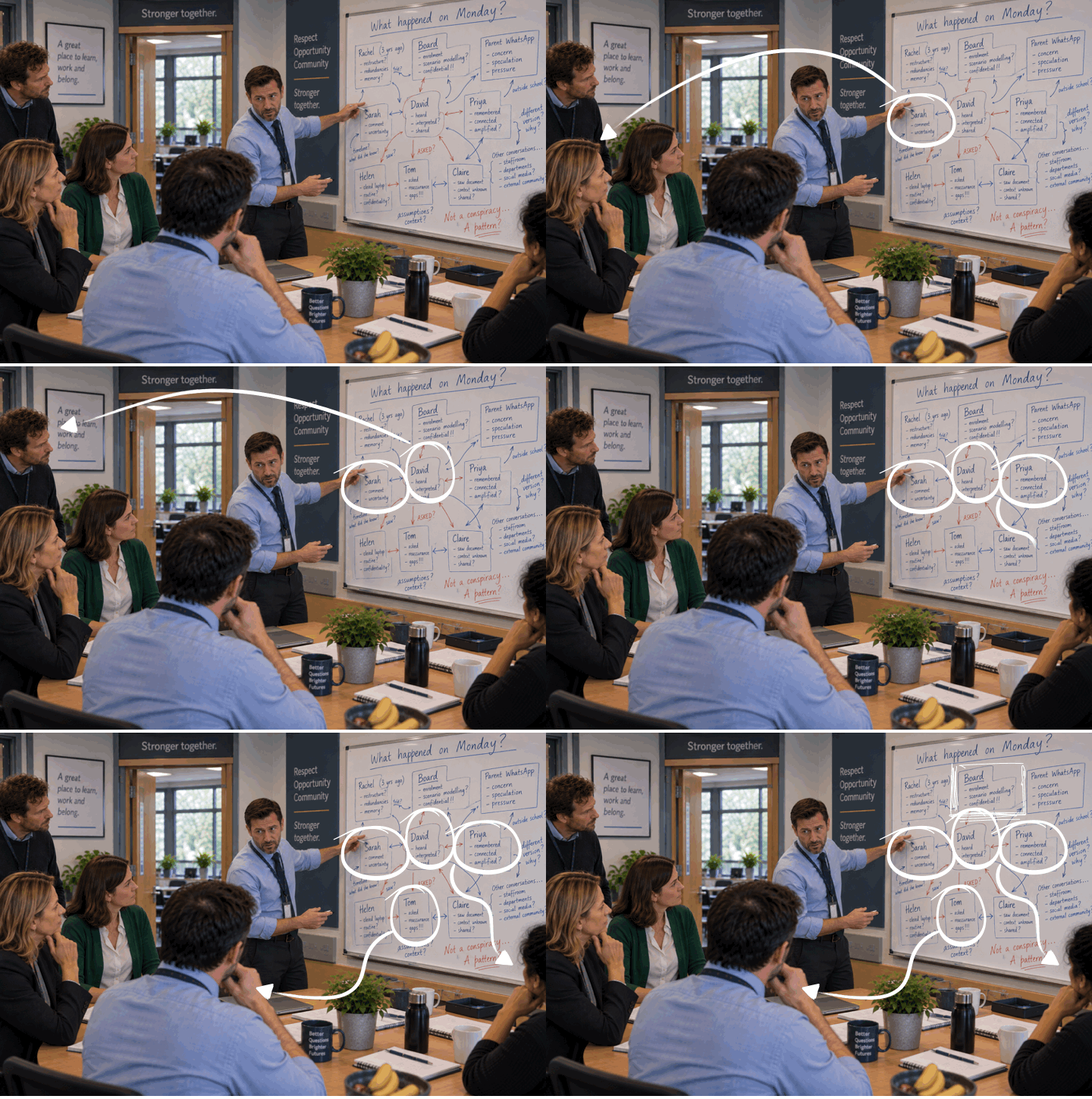
Some lines moved forward. Others travelled backwards years. Some joined events that had never actually been connected. Martin stepped away.
Nobody spoke.
James finally said:
“That is a mess.”
“No,” Claire said.
Everyone looked at her. She was staring at the board.
“I think that’s the first time today it hasn’t been.”
Martin looked again.
She was right.
On the board, the rumour no longer looked mysterious. It looked almost inevitable. That bothered him more. He had spent the morning looking for the point where somebody had behaved irrationally. There wasn’t one.
There were poor judgements. There were assumptions.
There was forgotten information. There were things repeated too confidently. There were things withheld for legitimate reasons. There was history.
There was fear.
There were relationships.
There were gaps.
But there was no single moment at which a sensible organisation had suddenly become an irrational one. The story had not travelled through the school despite the way the organisation worked. It had travelled through the school because of the way the organisation worked. Martin put the marker down. Nobody had invented the story. That was the problem.
Scene 8 - Monday, 1:18
Nobody seemed ready to leave.
The bell had gone three minutes earlier. Anna looked at the clock.
“I have Year 8.”
“So do I,” James said. Neither moved.
Martin looked at the whiteboard.
“Go.”
There was a general movement towards bags and cups. Priya stood, then stopped.
“What happens to that?”
She pointed at the board. Martin looked at it.
“I don’t know.”
“You’re going to wipe it off?”
“Eventually.”
“That isn’t what I meant.”
Martin waited.
Priya picked up her bag.
“What happens now?”
It was a reasonable question. Martin didn’t have an answer. Helen did.
“We correct the misinformation.”
Priya looked at her.
“And then?”
“We make sure parents know History isn’t being cancelled.”
“And then?”
Helen hesitated.
“We review how the enrolment information was communicated.”
Priya nodded.
“And then?”
Helen looked irritated.
“What are you asking?”
Priya glanced at the whiteboard.
“Which bit of that are we fixing?”
Nobody answered.
The bell rang again. James headed for the door.
“Definitely Year 8 now.”
The room emptied.
Priya left last.
Martin and Helen remained. Helen stared at the whiteboard.
“She has a point.”
Martin smiled.
“Careful.”
“Don’t enjoy it.”
She walked closer.
“Where would you start?”
Martin looked at the web of arrows.
“Three years ago?”
“Very funny.”
“I’m not joking.”
Helen turned.
“You want to reopen a staffing decision from three years ago?”
“No.”
“Good.”
“I want to understand why it’s still in the room.”
Helen looked back at the board. The words sat at the far left:
Three years ago - staffing changes after reassurance.
“That wasn’t our decision,” she said.
“I know.”
“Different Head.”
“I know.”
“Different Board.”
“I know.”
“And as far as I understand, what staff were told was accurate.”
Martin nodded.
“That seems to be becoming a theme.”
Monday, 1:24
Helen picked up the marker.
She drew a box around:
OPEN COMMUNICATION
Martin looked at her.
“What are you doing?”
“I don’t know yet.”
She drew a line from it to:
Middle leaders receive enrolment figures.
Then another to:
‘Please give teams appropriate context.’
Then:
Claire forgets.
She stepped back.
“Well, that’s uncomfortable.”
Martin smiled.
“Keep going.”
Helen drew another line.
No staffing decision → no communication to all staff.
Then:
Staff see vacancy / questions / document.
She stopped.
“We designed a process.”
“Yes.”
“It didn’t produce what we intended.”
“Yes.”
“Because Claire forgot.”
Martin shook his head.
“No.”
“She did.”
“Yes. But Tom didn’t forget.”
Helen looked at him. Martin took the marker. Beside Claire’s name he wrote:
FORGOT
Beside Tom:
CHOSE NOT TO SHARE
Beside himself:
COULD NOT SHARE EVERYTHING
Beside Helen:
DELEGATED CONTEXT
Then he drew a bracket around all four.
“If four different people can behave differently and we still end up in the same place, I’m not sure the individuals are the useful unit of analysis.”
Helen read the board.
“You’re enjoying this now.”
“A little.”
She took the marker back.
“What about Sarah?”
Martin wrote:
INFERRED
“Priya?”
REMEMBERED
“Mark?”
Martin thought.
EXPECTED
“Parents?”
SOUGHT REASSURANCE
Helen looked at the list.
“None of those is inherently unreasonable.”
“No.”
“Repeating an unverified restructure is.”
“Yes.”
“So don’t lose that.”
Martin nodded.
“I’m not.”
“Because I can already see where this goes. We diagnose the system so thoroughly that nobody is responsible for anything.”
Martin looked at her.
“That would be a mistake.”
“A fairly serious one.”
“Yes.”
Helen pointed at Sarah’s name.
“She made an inference and repeated it.”
“Yes.”
“David repeated it.”
“Yes.”
“Someone turned three departments into three posts.”
“Yes.”
“People have agency.”
“Yes.”
“And trust isn’t an excuse for carelessness.”
“No.”
Helen put the marker down.
“Good.”
Martin looked at the board.
“But carelessness isn’t an excuse for not examining the conditions that made it consequential.”
Helen didn’t answer immediately.
“No,” she said. “It isn’t.”
She looked at the four names and the four words beneath them.
“If four people can behave four different ways and land in the same place, then I don’t get to call it a communications failure and go home. Even if some of those four people were careless.”
“Including you.”
“Including me. I wrote ‘appropriate context’ and then acted as though the middle leaders would know what I meant.”
“And the middle leaders?”
“Have agency,” she said. “And so do I. I’d rather have both problems than pretend one isn’t there.”
Martin picked the marker back up.
“That’s better than either of us managed this morning.”
Helen smiled.
“There he is.”
Monday, 3:42
The school was quieter.
Students had gone.
A cleaner pushed a trolley past the staffroom. The whiteboard was still covered. Sarah stood in front of it alone. She had come in to make tea. Instead she found herself reading. Martin’s handwriting was terrible. Helen’s was worse.
She found her own name.
INFERRED
She didn’t particularly like it. It sounded clinical.
She picked up the marker. Underneath she wrote:
SAID I DIDN’T KNOW
Then she stood back. That looked defensive.
She wiped it off. She tried:
SAW A PATTERN
She stared at that. Wiped it off too. Finally she wrote:
WONDERED
That felt closer.
She put the marker down.
“Improving my work?”
Sarah turned.
Martin was in the doorway.
“Correcting it.”
“Fair.”
He walked over.
He read her addition.
SARAH - WONDERED
He nodded.
“Better.”
Sarah folded her arms.
“Am I in trouble?”
Martin looked genuinely surprised.
“No.”
“Okay.”
“Did you think you were?”
“Yes.”
“Why?”
Sarah laughed.
“Seriously?”
“Yes.”
She looked at him.
“Because by ten o’clock there was a school-wide rumour, my name was attached to it and you were trying to work out where it came from.”
“Fair.”
“And because Helen closed her laptop when I came to your office.”
Martin frowned.
“What has that got to do with anything?”
“Nothing.”
He waited.
Sarah sighed.
“Priya said that’s what happened last time.”
Martin looked at the board. The line running backwards three years.
“Right.”
“She wasn’t saying you did anything.”
“I know.”
“Or Helen.”
“I know.”
“It was just…”
Sarah searched for the word.
“Familiar.”
Martin nodded.
“Can I ask you something?”
“Sure.”
“When you saw the document on Friday, why didn’t you ask me?”
Sarah smiled.
“Everyone keeps asking me that.”
“I’m beginning to suspect the answer matters.”
She thought.
“Because I didn’t know there was anything to ask.”
Martin waited.
“I saw a staffing document. Fine. You ask about student numbers all the time. Fine. Dan hasn’t been replaced. Also fine.”
“So?”
“So none of those things individually justified marching into your office asking whether people were losing their jobs.”
“Agreed.”
“But together…”
She looked at the board.
“They started to look like something.”
“Enough to tell the staffroom.”
Sarah winced.
“Yes.”
“But not enough to ask me.”
She looked at him.
“That sounds bad when you say it like that.”
“I’m not trying to catch you out.”
“I know.”
She thought again.
“It was easier.”
“What was?”
“Saying it in the staffroom.”
“Why?”
Sarah gave him a look.
“Because if I say to Anna, ‘Do you think something’s going on?’ I’m wondering.”
“And if you say it to me?”
“I’m accusing.”
Martin opened his mouth. Then stopped.
Sarah pointed at the board.
“Put that up there.”
Martin picked up the marker.
SAME QUESTION. DIFFERENT RELATIONSHIP.
He underlined it.
Sarah watched.
“That’s closer.”
Monday, 3:51
“Can I ask you one?”
Sarah said it differently this time. Martin noticed.
“Go on.”
“Why hasn’t Dan’s job been advertised?”
Martin leaned against the table.
“We don’t know whether we need to replace it like-for-like.”
Sarah waited.
“Because of enrolment?”
“Partly.”
“What else?”
“Curriculum choices. Timetable. Where the demand is.”
“Could Humanities lose the post?”
“Yes.”
There it was.
Sarah looked at him.
“So I wasn’t completely wrong.”
“No.”
“But there’s no restructure.”
“No.”
“And nobody has decided to remove the post.”
“No.”
“But you’re considering not replacing it.”
“We’re considering several configurations.”
Sarah laughed softly.
“What?”
“Nothing.”
“Sarah.”
“You do hear yourself sometimes?”
Martin smiled.
“Occupational hazard.”
She looked at the board.
“So what was the correct version?”
“Of what?”
“What I should have said this morning.”
Martin thought.
Perhaps:
Leadership is reviewing whether Dan’s post needs to be replaced like-for-like as part of normal staffing planning.
Accurate.
Clear.
Also not something Sarah could possibly have known.
“I don’t think you had one.”
She looked at him.
“You had pieces.”
“Yes.”
“You made an interpretation.”
“Yes.”
“And you treated the interpretation as more certain than the evidence justified.”
Sarah considered that.
“That’s fair.”
“But the interpretation wasn’t absurd.”
“No.”
“And some of the evidence behind it was real.”
“Yes.”
They stood looking at the board. Sarah pointed at the strategic plan on the wall.
“Open communication.”
“Yes.”
“Doesn’t mean everyone knows everything.”
“No.”
“Doesn’t mean everyone says everything.”
“No.”
“So what does it mean?”
Martin looked at the words. For the first time all day, he found the statement irritating. Not because it was wrong. Because it was so easy to agree with.
“I don’t know.”
Sarah smiled.
“You should put that on the poster.”
Tuesday, 8:02
The whiteboard had survived the cleaners.
Someone had added to it. Martin noticed when he walked into the staffroom. Under:
SAME QUESTION. DIFFERENT RELATIONSHIP.
someone had written:
Same silence. Different meaning.
Below that:
Same evidence. Different conclusion.
Then:
Same history. Different memory.
And, in different handwriting:
Same school. Different experience.
Martin stood reading.
“Morning.”
Priya was making coffee.
“Was this you?”
“Which bit?”
He pointed.
She smiled.
“Some.”
“Who wrote the rest?”
“No idea.”
Martin looked at her.
“Seriously.”
“Seriously.”
He turned back to the board. Someone had drawn a line from:
OPEN COMMUNICATION
to:
What did we intend people to understand?
Another line ran from the middle-leader message to:
What actually happened?
A third ran from the staffroom conversation to:
What did people experience?
And underneath the parent WhatsApp message:
What told them it was true?
Martin stared.
Four questions.
He didn’t know who had written them. He didn’t particularly care. Something about them made yesterday’s mess look different. Not simpler.
Structured.
Priya came to stand beside him.
“Interesting, isn’t it?”
“Yes.”
“What are you going to do with it?”
Martin looked at the four questions again. What were we trying to make true? What shaped what happened? What actually happened?
What told us?
He picked up the marker. Then stopped.
“No.”
Priya looked at him.
“No?”
“I think we’ve done enough writing.”
He put the marker down.
“Let’s see what happens next.”
At 8:06, Sarah entered the staffroom. She looked at the board. Then at Martin.
“You’re still here.”
“Apparently.”
She put down her coffee. Behind her, the door remained open. People passed in the corridor. Some looked in.
Some didn’t.
Nothing about the school had changed overnight. The strategic plan still said the same thing. The staffing scenarios still contained the same numbers. Dan’s post was still vacant. Priya still remembered three years ago. Sarah still wished she’d chosen her words more carefully. Martin still couldn’t tell everyone everything. The rumour was still wrong. The concern behind it was still real. What had changed was smaller. They had stopped asking only:
Who started it?
And begun asking:
What made it possible?
Scene 9 - Tuesday, 10:36
The email went out at morning break.
Martin had rewritten it six times. Helen had rewritten it twice more. The final version was shorter than either of them expected.
Colleagues,
Yesterday there was considerable discussion about possible staffing changes. Some of what circulated was incorrect. Some of it was based on things that are real: enrolment is below forecast, we are reviewing next year’s staffing as part of normal planning, and Dan’s vacant post has not yet been confirmed for replacement.
No decision has been made to restructure Humanities, remove three posts or discontinue History. We also recognise that saying only “no decision has been made” does not necessarily answer the questions people have. We will use Thursday’s staff meeting to share what we can, identify what remains uncertain, and hear what people are seeing that we may not be. Until then, please distinguish between what you know, what you have heard, and what you are inferring.
Martin
Helen read it one final time.
“You realise the sentence everyone’s going to notice.”
“Which one?”
“Dan’s post.”
“Yes.”
“We’ve just confirmed that not replacing it is possible.”
“Yes.”
“That will create more questions.”
“Yes.”
Helen looked at him.
“And you’re comfortable with that?”
“No.”
She smiled.
“Good.”
Martin pressed send.
Tuesday, 10:41
Sarah read the email twice.
The first time as a teacher. The second time as the person whose comment had started yesterday morning. She stopped at:
distinguish between what you know, what you have heard, and what you are inferring.
It felt aimed at her. She felt the familiar defensive response rising. Then she read the sentence before it again.
hear what people are seeing that we may not be.
She wasn’t sure what to do with that. She forwarded the email to nobody. That felt like progress. Priya read it in the corridor. She stopped at:
Some of it was based on things that are real.
She read that sentence again. Three years ago, the school would never have written that. Or perhaps it would. Memory was slippery like that. She had spent most of yesterday treating her memory as evidence. Now she wondered what the evidence actually was. She opened her email and searched the name of the previous Head. Three years of messages appeared. She typed:
staffing
Seventeen results.
She opened the first relevant one.
As shared at Tuesday’s meeting, enrolment projections remain uncertain. No staffing decisions have been taken and we will update colleagues as planning develops.
Priya frowned.
That wasn’t how she remembered it. She opened another.
Two weeks later:
We are now beginning consultation regarding a small number of staffing adjustments for the coming academic year.
She stared at the dates. Nineteen days apart.
In her memory, they had become almost the same event. Reassurance.
Then job losses.
Betrayal.
Nineteen days was not very long. But it wasn’t the sequence she had been carrying either. She kept searching.
Tuesday, 10:48
Tom found her sitting alone at the end of the library.
“Research?”
Priya turned the laptop slightly.
“The last restructure.”
Tom sat opposite.
“Find anything?”
“Yes.”
“And?”
She looked irritated.
“It’s annoyingly complicated.”
Tom smiled.
“The worst kind of evidence.”
Priya ignored him.
“They did tell us.”
“About the changes?”
“Eventually.”
She scrolled.
“And before that they told us no decisions had been made.”
“Were they lying?”
“I don’t think so.”
“Then what happened?”
Priya leaned back.
“Things changed.”
Tom waited.
“Applications dropped again. Finance revised the forecast. Then they made decisions.”
“So what do you think they should have done differently?”
“I don’t know.”
She said it without embarrassment this time.
“Maybe nothing.”
Tom looked surprised.
“That’s quite a shift from yesterday.”
“I didn’t say nothing went wrong.”
“What went wrong?”
Priya turned the screen back towards herself.
“I think I learned the wrong lesson.”
Tom waited.
“I learned that when leadership says nothing has been decided, it means something bad has already been decided and they aren’t telling us.”
“Was that true?”
“No.”
She looked at him.
“But here’s the problem. It worked.”
“What did?”
“My interpretation.”
Tom frowned.
“Something bad did happen.”
“Later.”
“Yes.”
“So every time something feels similar, I get to say, ‘See? I knew it.’”
Tom nodded.
“Even if the situations aren’t the same.”
“Exactly.”
She closed the laptop.
“That doesn’t mean I was wrong yesterday.”
“No.”
“It means being right wouldn’t prove why.”
Tom smiled.
“That’s annoyingly complicated.”
“Shut up.”
Tuesday, 11:03
Helen was looking at different evidence.
She had asked Leila to pull the staff survey results from the previous two years. The communication scores were good. Very good, in fact.
I receive the information I need to do my job effectively. - 87% positive
School leaders communicate clearly about important matters. - 82%
I know where to raise concerns or questions. - 91%
Helen stared at the figures. Martin came in.
“Good news?”
“Apparently we’re excellent communicators.”
“Excellent.”
She turned the laptop towards him. He read.
“That’s reassuring.”
“You don’t sound reassured.”
“Yesterday happened.”
Helen scrolled.
“Eighty-seven percent.”
“Yes.”
“That’s not ambiguous.”
“No.”
“So either yesterday was unusual - ”
“Probably.”
“ - or this is measuring something different.”
Martin looked closer.
“What was the question again?”
Helen read it.
“‘I receive the information I need to do my job effectively.’”
Martin nodded.
“That may be true.”
“And still not tell us whether people trust what they hear when they’re uncertain.”
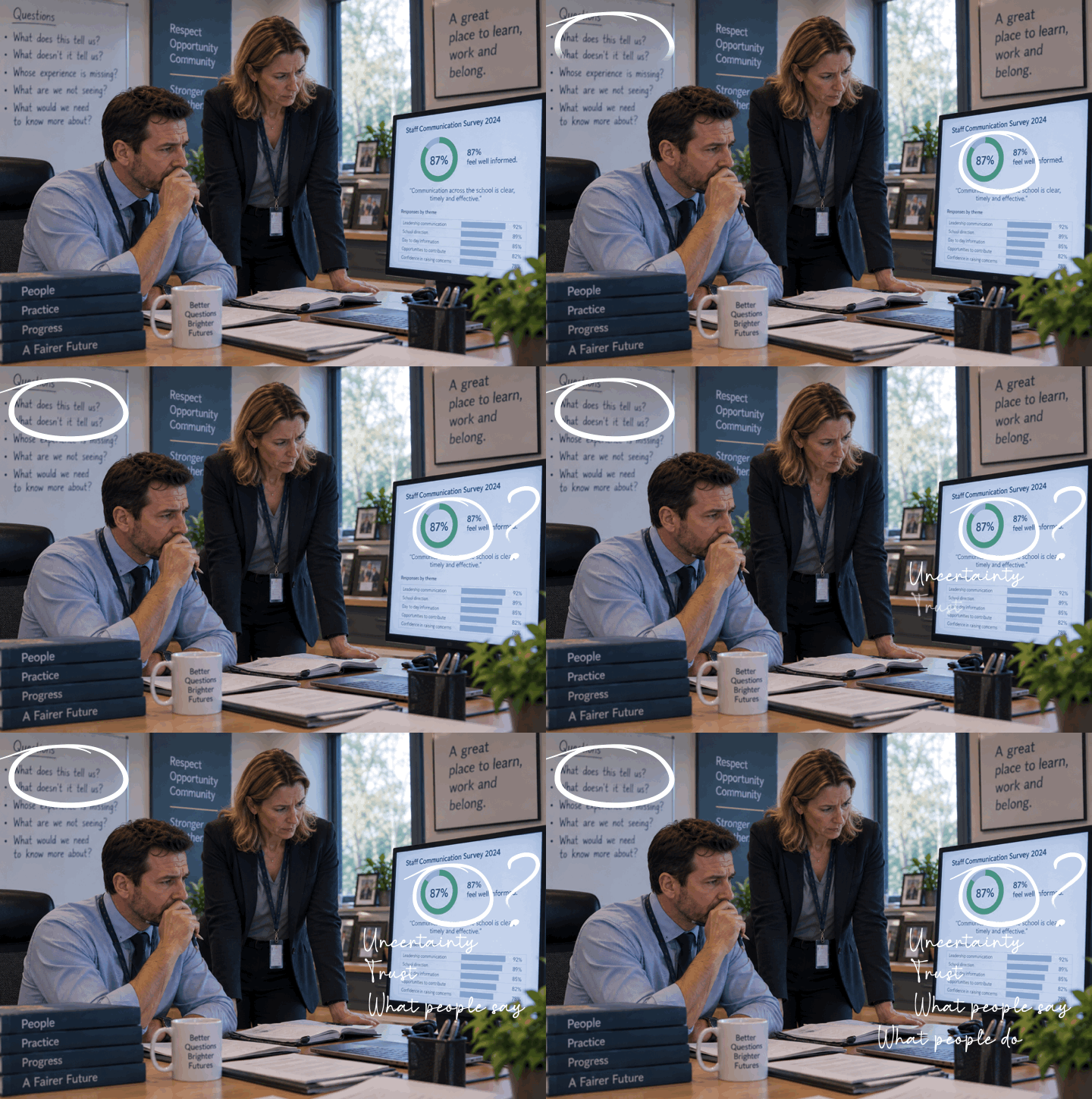
“No.”
She opened another tab.
“Here’s last year’s parent survey.”
The school communicates effectively with families. - 89% positive.
Martin laughed.
Helen looked at him.
“I’m glad you’re enjoying yourself.”
“We’ve got proof.”
“Of what?”
“Exactly.”
Tuesday, 11:17
They printed the survey results.
Helen took them to the staffroom. The whiteboard was still there. She pinned the page beside it. At the top she wrote:
PROOF?
Then left.
She didn’t explain.
At lunchtime, somebody had circled the question mark. Someone else had drawn an arrow from 87% to:
OF WHAT?
Underneath:
When things are routine?
Another hand added:
When things are uncertain?
Then:
When the answer is something we don’t want to hear?
By 12:30, the margin was full. Martin stood in the doorway reading. This was beginning to get out of hand again. Only this time he wasn’t entirely sure he wanted to stop it.
Tuesday, 12:36
James appeared beside him.
“Interesting.”
“Yes.”
“You know what I think?”
“I suspect you’re going to tell me.”
“The survey is right.”
Martin turned.
James pointed.
“I do get the information I need to do my job.”
“Okay.”
“You send too much of it, actually.”
“Thank you.”
“Weekly bulletin. Calendar. Briefings. Teams. Emails. Department meetings. Nobody can accuse this place of not communicating.”
“That’s reassuring.”
“But yesterday wasn’t about information.”
Martin looked at him.
“What was it about?”
James shrugged.
“Meaning.”
Martin waited.
James pointed at the board.
“We had information. Loads of it.”
Dan hadn’t been replaced. Enrolment was down.
Martin had asked about option numbers. A staffing document existed. Middle leaders had received figures. No decision had been made. “All true,” James said.
“Yes.”
“And completely useless unless you knew what they meant together.”
Martin looked again at the survey.
“So what should we measure?”
James laughed.
“Absolutely no idea.”
“Very helpful.”
“You’re the Head.”
“So I’m told.”
James started towards the door. Then turned.
“Actually.”
Martin waited.
“Maybe that’s the wrong question too.”
“What is?”
“What should we measure?”
“What would you ask?”
James thought.
“Maybe: When something doesn’t make sense here, what do you do?”
Martin looked at him. James shrugged.
“I’d be interested in the answer.”
He left.
Tuesday, 3:16
The answer arrived sooner than either expected.
Leila appeared at Martin’s door.
“You have a visitor.”
“Who?”
“Rachel Foster.”
Martin didn’t recognise the name. Leila did.
“She used to work here.”
Martin looked at her.
“When?”
“Three years ago.”
He understood.
“Priya’s Rachel?”
Leila looked confused.
“I don’t know whose Rachel she is.”
“Never mind.”
“She’s picking up her son. She asked if you had five minutes.”
Martin checked his calendar.
“Send her in.”
Rachel looked nothing like the character Martin had constructed from Priya’s story. That irritated him immediately. In his imagination she had become almost symbolic: the colleague with the white envelope, the casualty of poor communication. The real Rachel wore muddy running shoes and carried a supermarket bag.
“Sorry to ambush you.”
“Not at all.”
She sat.
“I had a strange message from Priya.”
Martin smiled.
“That seems to be happening a lot this week.”
“She asked me what I remembered about the staffing changes.”
“And?”
“I thought I’d better check you weren’t firing everyone again.”
Martin laughed despite himself.
“We’re not.”
“Good.”
She looked around the office.
“Different furniture.”
“Apparently.”
“Same terrible blinds.”
Martin waited.
Rachel smiled.
“Priya remembers it badly.”
That wasn’t what he expected.
“Badly?”
“Not wrongly.”
Rachel considered.
“We were told there was a problem. We were told they were looking at options. We knew jobs could be affected.”
Martin frowned.
“Priya remembers being reassured.”
“We were.”
“So which was it?”
“Both.”
Rachel shifted in the chair.
“They told us they would try to protect jobs.”
“And?”
“They did.”
Martin waited.
“Mine wasn’t protected.”
She said it without drama.
“I’m sorry.”
“Don’t be. It worked out.”
“That isn’t really the point.”
“No.”
She smiled.
“You’re doing the Head thing.”
“What Head thing?”
“Trying to make the past administratively correct.”
Martin sat back.
“Fair.”
Rachel looked towards the window.
“The thing I remember isn’t what they told us.”
“What is?”
“The waiting.”
Martin said nothing.
“Every meeting felt significant. Every closed door. Every time someone from Finance came upstairs. Every time the Head asked for numbers.”
She laughed.
“I remember somebody saying the photocopier breaking down was probably part of the restructure.”
Martin smiled.
“We’ve apparently improved. Ours started with a laminator.”
Rachel looked puzzled.
“Long story.”
She continued.
“The school kept saying no decisions had been made.”
“Which was true.”
“Yes.”
“But?”
“No but.”
Martin waited.
Rachel looked at him.
“That was the problem.”
“I don’t understand.”
“They thought the uncertainty was something they had to explain away.”
Martin said nothing.
“But the uncertainty was real.”
She leaned forward.
“Imagine being told every Friday that no decision has been made about whether you’ll have a job in August.”
Martin winced.
“Exactly.”
“So what should they have said?”
Rachel shrugged.
“I don’t know. Maybe, ‘This is horrible.’”
Martin looked at her.
“That’s it?”
“No. Obviously not.”
She smiled.
“But it would have been a start.”
Tuesday, 3:31
After Rachel left, Martin returned to the staffroom.
Nobody was there.
He looked at the whiteboard. At the strategic priority. At the survey results. At the web they had drawn the previous day. He picked up the marker. Under OPEN COMMUNICATION, he wrote: PURPOSE.
Beside the middle-leader message: PROCESS.
Beside the staffroom conversation: PRACTICE.
Beside the survey: PROOF.
He stepped back.
Four words.
For a moment, the board looked satisfyingly organised. Then Martin noticed the problem. He had put the survey under Proof. But Priya’s memory was proof too. So was Rachel’s account. So was the parent WhatsApp group. So was Sarah’s observation. So was the fact that three departments were below forecast. So was the 87%. They didn’t all prove the same thing. He drew lines.
From PURPOSE to PROCESS: did the way they communicated support the openness they claimed to value?
From PROCESS to PRACTICE: did information actually travel as the process assumed?
From PRACTICE to PROOF: what evidence described what people actually experienced?
Then he stopped. The survey told him something about practice. But it also made him question what they meant by open communication in the first place. He drew a line back.
From PROOF to PURPOSE. The board was becoming messy again. He smiled.
That seemed appropriate.
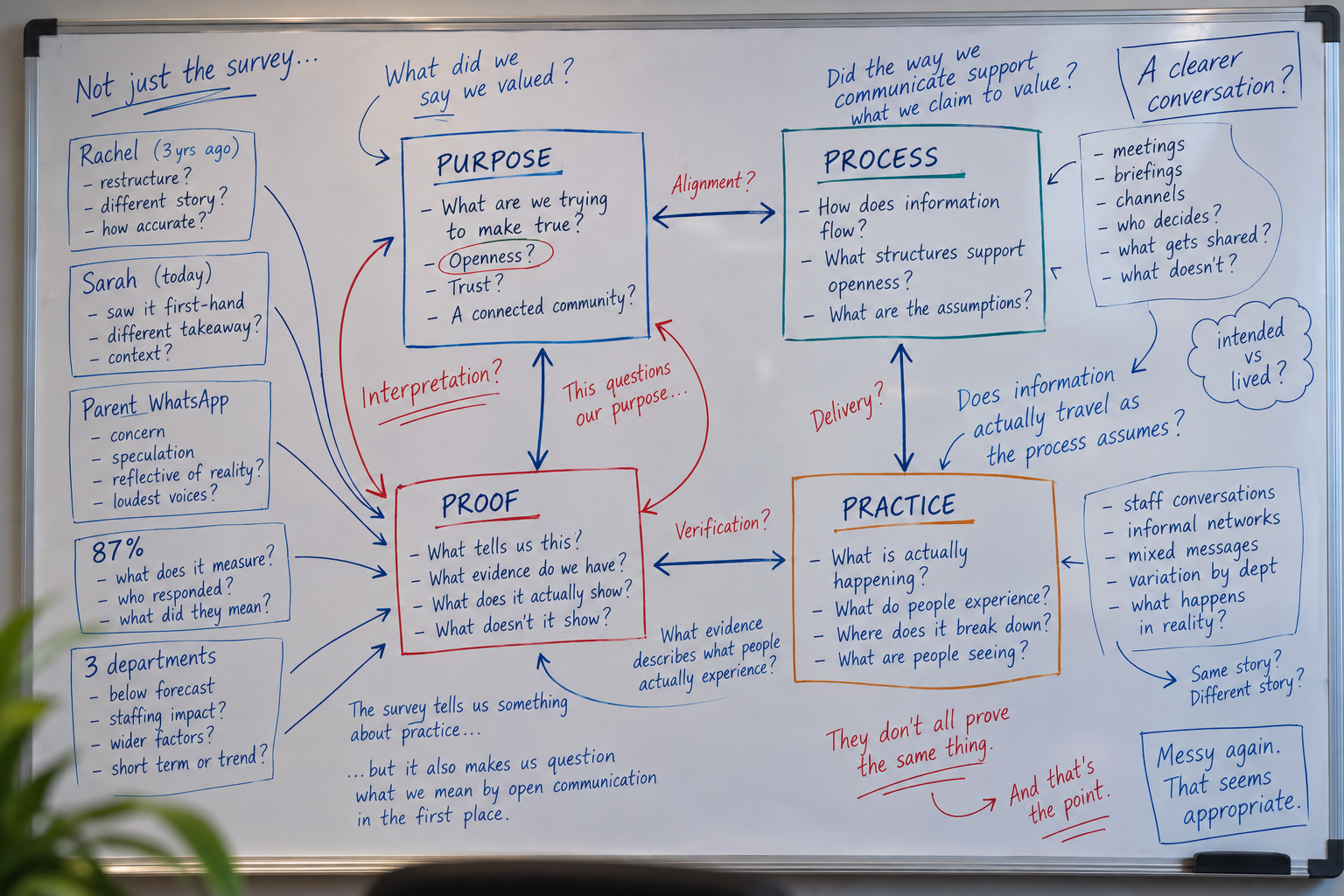
His phone buzzed.
Peter.
Any quieter today?
No.
Better.
PeterThose aren’t usually the same thing.
Martin looked again at the board. Perhaps that was another assumption worth examining.
Scene 10 - Thursday, 3:34
By Thursday afternoon, the rumour had mostly disappeared.
Nobody had announced that it was over. It had simply run out of places to go. History was still on the options sheet. Nobody had been called into an unexpected meeting. Dan’s vacancy was still vacant. And Martin’s Tuesday email had removed just enough uncertainty to make the remaining uncertainty less interesting. At 3:34, forty-six members of staff sat in the library for the weekly meeting. On the screen behind Martin was a single sentence.
What actually happened?
Sarah saw it and looked at Priya.
“Oh God.”
Priya smiled.
“You started it.”
Sarah didn’t.
Martin waited for the room to settle.
“I was going to spend fifteen minutes explaining what happened on Monday.”
A few people shifted.
“I’ve decided not to.”
Helen, sitting at the side, looked up. That wasn’t the opening they’d agreed. Martin continued.
“Because I don’t think I know.”
A few smiles.
“I know some of what happened. I know Sarah saw a staffing document.”
Forty-five heads turned towards Sarah. Martin stopped.
“That was badly phrased.”
Laughter.
Sarah covered her face.
“Sorry, Sarah.”
“Bit late now.”
More laughter.
Martin smiled.
“Let me try again.”
He clicked.
A photograph appeared.
The staffroom.
Empty.
The strategic plan visible on the wall.
“On Monday morning, several colleagues had a conversation in here.”
He clicked again.
I think they’re restructuring Humanities.
Nothing else.
“I could tell you what happened next. But most of you already know some version of it.”
A few people nodded.
“So instead, I want to ask you something.”
He looked around the room.
“When did this become a rumour?”
Silence.
Then someone at the back:
“When it left the staffroom.”
“Why?”
“Because it was being repeated.”
Martin nodded.
“Anyone else?”
Claire raised her hand.
“When someone treated an assumption as a fact.”
“Okay.”
Another voice.
“When three departments became three redundancies.”
Martin wrote that down. Tom raised his hand.
“Why are we assuming it became a rumour at a particular point?”
Martin looked at him. Tom continued.
“Maybe different parts were true and false all the way through.”
Helen smiled.
Martin wrote that down too. Then Mark said:
“Maybe it was a rumour from the beginning.”
Sarah turned.
“Thank you, Mark.”
Laughter again.
Mark held up his hands.
“You said I think.”
“I know.”
“So you were passing on something you believed might be true without knowing whether it was.”
Sarah considered.
“Fair.”
Martin looked around.
“So Sarah shouldn’t have said anything?”
Several people answered at once.
“No.”
“Yes.”
“Depends.”
Martin smiled.
“Useful.”
Thursday, 3:41
He changed the slide.
WHAT SHOULD SARAH HAVE DONE?
This time the room responded immediately.
“Ask you.”
“Check with her Head of Department.”
“Say nothing.”
“Ask Helen.”
“Wait.”
“Tell people what she’d seen but not what she thought it meant.”
Martin stopped at that one.
“Say that again.”
David, sitting near the back, repeated it.
“She could have said, ‘I saw a staffing document and Martin’s been asking about numbers. Does anyone know what that’s about?’”
Sarah turned around.
“That is almost exactly what I did.”
David laughed.
“No, it isn’t.”
“It basically is.”
“You said restructure.”
“Because that’s what I thought it meant.”
“Exactly.”
Sarah paused.
“Okay.”
Martin wrote:
OBSERVATION → INTERPRETATION
“What happened between those?”
James answered.
“Brains.”
The room laughed.
Martin nodded.
“Annoyingly accurate.”
He added:
OBSERVATION → ? → INTERPRETATION
“What goes in the middle?”
“Experience.”
“Assumptions.”
“History.”
“Fear.”
“Context.”
“Knowledge.”
“Relationships.”
“Bias.”
“Trust.”
Martin stopped writing.
The board was filling quickly.
“Interesting.”
He circled TRUST.
“Why trust?”
Priya answered.
“Because it affects which interpretation you’re prepared to believe.”
Martin looked at her.
“Can we use your example?”
Priya hesitated.
Then nodded.
Martin told the room what had happened three years earlier. Not the details of Rachel’s employment. Just the sequence.
Uncertain enrolment.
Reassurance.
Later change.
Then he said:
“Priya remembered that as evidence that reassurance can precede staffing changes.”
Priya nodded.
“Reasonable?”
Several people murmured agreement.
“Rachel remembers the same period differently.”
Priya looked surprised.
“You spoke to Rachel?”
“She spoke to me.”
“What did she say?”
“That the school did tell people jobs could eventually be affected.”
Priya frowned.
Martin continued.
“Neither account appears to be fabricated.”
He wrote:
SAME HISTORY → DIFFERENT MEMORY
“Which one is proof?”
Nobody answered.
“Both?” someone offered.
“Maybe.”
Helen spoke from the side.
“Proof of different things.”
Martin looked at her.
“Yes.”
He underlined it.
Thursday, 3:49
Martin changed the slide.
The staff survey appeared.
87% - I receive the information I need to do my job effectively.
“Apparently,” he said, “we’re very good at communication.”
A few laughs.
“Is this evidence?”
“Yes.”
“Good evidence?”
“Yes.”
“Does Monday prove it’s wrong?”
“No.”
“So what does Monday prove?”
A teacher near the front raised her hand.
“That communication works differently when people are anxious.”
Martin nodded.
Another:
“The survey asks whether I get information. Not whether I trust the gaps.”
Martin stopped.
“Say that again.”
She did.
Helen wrote it down. Someone else added:
“Also, routine information has somewhere to go. Timetables, dates, procedures. Uncertainty doesn’t.”
Martin turned.
“What do you mean?”
“If I need to know when reports are due, there’s an answer.”
She shrugged.
“If I want to know whether falling enrolment might affect my job next year, maybe there isn’t one.”
“And what happens then?”
“People make one.”
The room became quieter.
Thursday, 3:55
Martin turned the projector off.
No slide.
No diagram.
Just the room.
“One thing before I stop talking,” he said. He looked at Priya, who nodded.
“On Tuesday I spoke to someone who was here three years ago. She lost her job in that round. I asked her what the school should have done differently.”
He paused.
“She said, ‘Maybe just tell us it’s horrible.’”
Nobody moved.
“That was the whole answer. After everything, that was it. Not a better plan. Not a better process.”
He looked at the plan on the wall beside the library entrance. The same four priorities appeared all around the school.
“I want to try something else.”
He pointed towards the strategic plan mounted beside the library entrance. The same four priorities appeared around the school.
“What’s our commitment?”
Several people read it.
“Open communication.”
“And what does that mean?”
Nobody answered immediately.
Eventually Anna said:
“Clarity, dialogue and transparency.”
“You’re reading the small print.”
“Yes.”
“Does that describe Monday?”
“No.”
Martin waited.
Tom spoke.
“Parts of it.”
Martin looked at him.
“Explain.”
“There was plenty of dialogue.”
Laughter.
“Fair.”
“And people were fairly transparent with the people they trusted.”
The laughter stopped.
Tom continued.
“Sarah didn’t hide what she thought from the staffroom. Priya didn’t hide what she remembered. Claire showed us the middle-leader message. You told me there were scenarios.”
He looked at Martin.
“The problem wasn’t that nobody communicated.”
“What was it?”
“The communication followed relationships more reliably than it followed the structure.”
That landed differently.
Martin didn’t write it down. He didn’t need to.
Thursday, 4:01
Helen stood.
“Can I complicate this?”
Martin gestured towards the front. She stayed where she was.
“We’re in danger of making everything leadership’s responsibility again.”
A few people shifted. Helen continued.
“Monday exposed weaknesses in how information moved. Fine. We need to own those.”
She looked around the room.
“But if you repeat something you don’t know is true, that is still your decision.”
Sarah nodded.
“If you turn three departments into three redundancies, that matters.”
Another nod.
“If someone says, ‘I don’t know,’ and you repeat only the interesting part, that matters.”
David looked down.
“If you have a concern and choose the staffroom because it is easier than speaking to the person who can answer it, that matters too.”
Sarah raised her hand.
“Can I respond?”
“Of course.”
“I agree.”
Helen looked slightly surprised. Sarah continued.
“But I think Monday also showed why the staffroom was easier.”
“Yes.”
“So if we just tell people to use the proper channels - ”
“We haven’t.”
“I know. I’m saying if we did.”
Helen nodded.
“Then we’d learn nothing.”
Sarah smiled slightly.
“Yes.”
Helen looked around.
“Responsibility works both ways.”
“Does it?” Nadia said. The room turned. She had not spoken in a staff meeting all year, and she looked as surprised as anyone.
“Sorry. It’s just - some of us can raise something and it costs nothing. Some of us raise it and we’re the difficult one for a year.”
Helen held her gaze for a moment.
“That’s fair.”
She looked around the room properly for the first time.
“Responsibility works both ways, and it doesn’t cost everyone the same.”
Priya spoke.
“More than both.”
Helen looked at her.
“What do you mean?”
Priya pointed around the room.
“That’s still leadership and staff.”
She looked towards Claire.
“What about middle leaders?”
Then towards Martin.
“The Board?”
Then at herself.
“People who’ve been here forever?”
A few smiles.
“New people?”
She nodded towards Tom.
“Parents? Students?”
She paused.
“We keep drawing one line up and down the organisation.”
She moved her finger vertically.
“But Monday didn’t move like that.”
She moved her hand across the room.
“It went sideways.”
Then backwards.
“And backwards.”
Then outward.
“And outside.”
Nobody said anything.
Thursday, 4:08
Martin turned the projector back on.
Not to a slide. To a photograph he’d taken of the staffroom whiteboard. The web.
Lines crossed everywhere.
Past events connected to current ones. Formal processes collided with informal conversations. Evidence sat beside assumptions. The strategic commitment hovered above the whole thing.
“This,” Martin said, “is what we drew on Monday.”
He waited.
“I thought it was a mess.”
Claire smiled.
“You were wrong.”
“I was.”
He pointed at the photograph.
“We’ve spent years drawing organisations as boxes.”
He traced an imaginary hierarchy.
“Board. Head. Leadership. Middle leaders. Teams.”
Then he pointed at the web.
“I’m beginning to think this is what the organisation actually looks like.”
Thursday, 4:12
The meeting should have finished.
Nobody had moved.
Martin looked at the clock.
“One last thing.”
Nobody groaned, which surprised him.
“There are two questions I haven’t asked today, and they’re the two I’d rather not.”
He looked at the plan on the wall.
“Is our commitment to open communication actually recognisable in what you experienced on Monday?”
Silence.
“Not what we wrote. Not what we meant. What you experienced.”
“No,” Sarah said.
“Anyone want to argue?”
Nobody did.
“Second one.” He turned back to the room. “Eighty-seven per cent of you told us you get the information you need to do your job. That was real evidence. Where did it come from?”
“The survey,” someone said.
“Yes. And who made the survey?”
A pause.
“We did.”
“Right.”
He let it sit.
“So did we communicate well, or did we design the thing that tells us we communicated well?”
Helen laughed, once, without much humour. “That’s your two,” she said.
“Yes.”
“And you didn’t want to ask them.”
“No.”
He looked back at the room.
“One last question.”
A collective groan.
“Genuinely.”
He went to the whiteboard. At the top he wrote:
RUMOUR
Then beneath it:
How do we stop it?
He stepped away.
“That’s where I started on Monday.”
He crossed it out. Underneath he wrote:
What made it believable?
Then:
What made it travel?
Then:
What did people do with uncertainty?
Then:
What evidence did they use?
Then:
What did our processes make easier - or harder?
Finally:
What were we trying to make true in the first place?
He put the marker down. Six questions, and they kept pairing up.
What did our processes make easier, or harder?
That one belonged with What made it travel? Design against reality. How the school was built against what people actually did inside it.
What made it believable?
That belonged with What evidence did they use? Reality against evidence. What people took as proof against what they were actually living.
What did people do with uncertainty?
That sat with What were we trying to make true in the first place? Intention against reality. The commitment on the wall against the week people had.
Three pairs. Purpose, Process, Practice, Proof - and the thing that had been travelling between them all day without appearing on any of them.
The story had not moved up and down the organisation. It had moved sideways, through who trusted whom, and backwards, through three years of someone else’s decision. None of that was on the wall. None of it was in the plan.
Martin stood back.
Four perspectives. And the fifth thing, which was where all four of them actually lived.
The names could wait. The pattern could not.
Helen smiled.
“Thank God.”
A few people laughed.
“I don’t think it’s another survey either.”
More laughter.
“And I’m fairly certain the answer isn’t a policy on gossip.”
Sarah raised her hand.
“Shame. I was hoping to chair the working group.”
This time everyone laughed. Martin waited.
Then he said:
“I think the answer is that we need to get better at seeing what is happening before we decide what it means.”
Thursday, 4:16
The meeting ended.
People packed bags.
Chairs scraped.
Small conversations formed.
Nothing particularly dramatic happened. Sarah walked towards the door with Priya. Halfway there, Priya stopped.
“By the way.”
Sarah looked at her.
“I owe you an apology.”
“For what?”
“Saying you started it.”
Sarah considered.
“I did start some of it.”
“Yes.”
“But not all of it.”
“No.”
Sarah smiled.
“That’s annoyingly complicated.”
“Apparently that’s the theme.”
They continued down the corridor. Behind them, Martin was wiping the whiteboard. He stopped before the final six questions. For a moment he considered leaving them. Then he wiped those too. The board became white again. The strategic plan remained on the wall beside it.
OPEN COMMUNICATION
We build trust through clarity, dialogue and transparency.
The words hadn’t changed. But they no longer looked like an answer. They looked like something the organisation would have to keep proving.
Epilogue - February
The decision was made on a Tuesday.
By Wednesday morning, everyone knew. This time, that was intentional. Enrolment had recovered slightly after Christmas, but not enough. The additional eight percent decline the Board had modelled never happened.
Five percent did.
It was enough.
Dan’s post would not be replaced like-for-like. There would still be History. There would still be Humanities. Nobody was being made redundant. But the department would be smaller next year, and some teaching would be redistributed. Martin told Sarah and the Humanities team first. Then middle leaders.
Then all staff.
Parents would receive the curriculum information the following week. The process was orderly. The communication was clear. Nobody enjoyed it.
At 10:17 on Wednesday, Sarah walked into the staffroom. Priya was making coffee. She looked up.
“So.”
Sarah put her bag down.
“So.”
“We were right.”
Sarah stopped.
“About what?”
Priya smiled.
“You know what I mean.”
“I genuinely don’t.”
“Humanities.”
“What about it?”
“They were looking at staffing.”
“Yes.”
“And Dan isn’t being replaced.”
“Yes.”
“Which is basically what we thought in September.”
Sarah pulled out a chair.
“No, it isn’t.”
Priya turned from the coffee machine.
“Come on.”
“We thought Humanities might be restructured.”
“It sort of is.”
“No. We thought there might be three redundancies.”
“I never said three.”
“Someone did.”
“Fine.”
“We thought History might disappear.”
“Parents thought that.”
“Exactly.”
Priya carried her coffee to the table.
“But the basic concern was right.”
Sarah nodded.
“Yes.”
Priya looked momentarily triumphant. Sarah continued.
“That doesn’t make the story right.”
Priya frowned.
“I’m not sure I see the difference.”
Sarah thought for a moment.
“If I tell you it’s going to rain tomorrow because my knee hurts, and it rains, was my knee a weather forecast?”
Priya laughed.
“That’s ridiculous.”
“Yes.”
“You saw an actual staffing document.”
“I know.”
“And enrolment actually was down.”
“I know.”
“And Dan actually wasn’t replaced.”
“I know.”
“So your evidence was rather better than your knee.”
Sarah smiled.
“Also true.”
She opened her laptop.
“But I still joined the pieces too confidently.”
Priya sat opposite.
“So what should you have concluded?”
“That something might be happening.”
“You did.”
“No. I said something was happening and then added ‘I think’ to it.”
Priya considered that.
“That is annoyingly different.”
“Yes.”
James entered carrying a stack of exercise books.
“What are we arguing about?”
“Whether Sarah predicted the future.”
“I did not.”
Priya said, “She sort of did.” James put the books down.
“Excellent. Can you do next year’s exam results?”
Sarah ignored him.
Priya looked at James.
“Dan’s post.”
“Oh.”
“We were saying the September rumour wasn’t entirely wrong.”
James pulled out a chair.
“Which September rumour?”
Priya stared at him.
“The Humanities restructure.”
“There wasn’t one.”
“The staffing rumour.”
“Which one?”
“The one about Dan’s post.”
“I thought it was three redundancies.”
Sarah pointed at him.
“Thank you.”
James shrugged.
“That’s what I remember.”
Priya looked from one to the other.
“Fine.”
She took a sip of coffee.
“We were right that there was something behind it.”
Sarah nodded.
“Yes.”
James nodded too.
“Yes.”
Priya waited.
“That’s it?”
Sarah smiled.
“That’s quite a lot.”
For a few seconds nobody spoke. Then James said:
“Actually, that’s slightly terrifying.”
“What is?”
“How easy it would be to remember this differently.”
Priya looked at him.
“In what way?”
“In two years’ time.”
He leaned back.
“We’ll say there were rumours about staffing, leadership denied them, and then they cut a Humanities post.”
Sarah frowned.
“They didn’t deny staffing was being reviewed.”
“I know.”
“They denied a restructure and redundancies.”
“I know.”
“And the decision wasn’t made until months later.”
“I know.”
James shrugged.
“But that’s a terrible story.”
Priya smiled.
“And the other one is better.”
“Much.”
Sarah looked at them.
“Which means?”
James picked up his books.
“In two years, you’re going to have to remind me about your knee.”
February, 10:24
Martin passed the open staffroom door.
He heard laughter.
That was all.
He kept walking.
At the end of the corridor, he stopped in front of the strategic plan. It had been replaced over Christmas. Same priorities.
New design.
OPEN COMMUNICATION
We build trust through clarity, dialogue and transparency.
He had argued for keeping the wording. Helen had wanted to change it. “Too vague,” she’d said. She wasn’t wrong.
But Martin had become less interested in finding better words for things the organisation still had to learn how to do. He continued towards his office.
February, 10:29
Behind him, Mark entered the staffroom.
“Has anyone heard about the timetable?”
Sarah looked up.
“What about it?”
“Apparently they’re changing the whole structure next year.”
Priya froze.
James slowly lowered an exercise book. Sarah looked at Mark.
“Who told you?”
“Nobody.”
That made everyone stop. Mark continued.
“I was with Claire earlier. She’s got a draft timetable with different lesson lengths.”
Priya put down her coffee.
“Different how?”
“I couldn’t see.”
“So how do you know the whole structure is changing?”
“I don’t.”
James smiled.
Mark caught himself.
“Right.”
He pulled out a chair.
“Okay. I saw a draft timetable. It had different times down the side.”
Sarah nodded.
“That’s what you know.”
“Yes.”
“Anything else?”
“Claire said she couldn’t talk about it yet.”
Priya raised an eyebrow. Mark pointed at her.
“Don’t.”
She laughed.
“What?”
“I know exactly what you’re thinking.”
“No, you don’t.”
“You’re thinking closed laptops.”
“I absolutely am.”
James shook his head.
“February. Different month.”
Mark looked around.
“So what do we think it means?”
Sarah opened her mouth. Then stopped.
“No.”
“Wrong question,” Nadia said, from the kettle. Everyone looked at her.
“What?” she said. “I’m allowed to have an opinion about it now.”
Mark looked at her.
“No?”
“Wrong question.”
She closed her laptop.
“What do we actually know?”
Mark repeated it.
“A draft timetable. Different lesson lengths.”
“Good.”
Priya added:
“And Claire can’t talk about it yet.”
Sarah looked at her.
“Do we know she can’t?”
Priya paused.
“No.”
“What do we know?”
“She said she couldn’t.”
“Better.”
James looked pleased.
“This is exhausting.”
“It really is.”
Mark leaned back.
“So now what?”
Sarah thought.
“We could ask.”
“Claire?”
“Seems reasonable.”
Mark looked doubtful.
“She said she couldn’t talk about it.”
Sarah shrugged.
“Then perhaps she can tell us what she can talk about.”
Priya picked up her coffee.
“And if she can’t?”
Sarah looked at her.
“Then we still don’t know.”
Martin was almost at his office when he realised he had left his phone in the staffroom. He turned back.
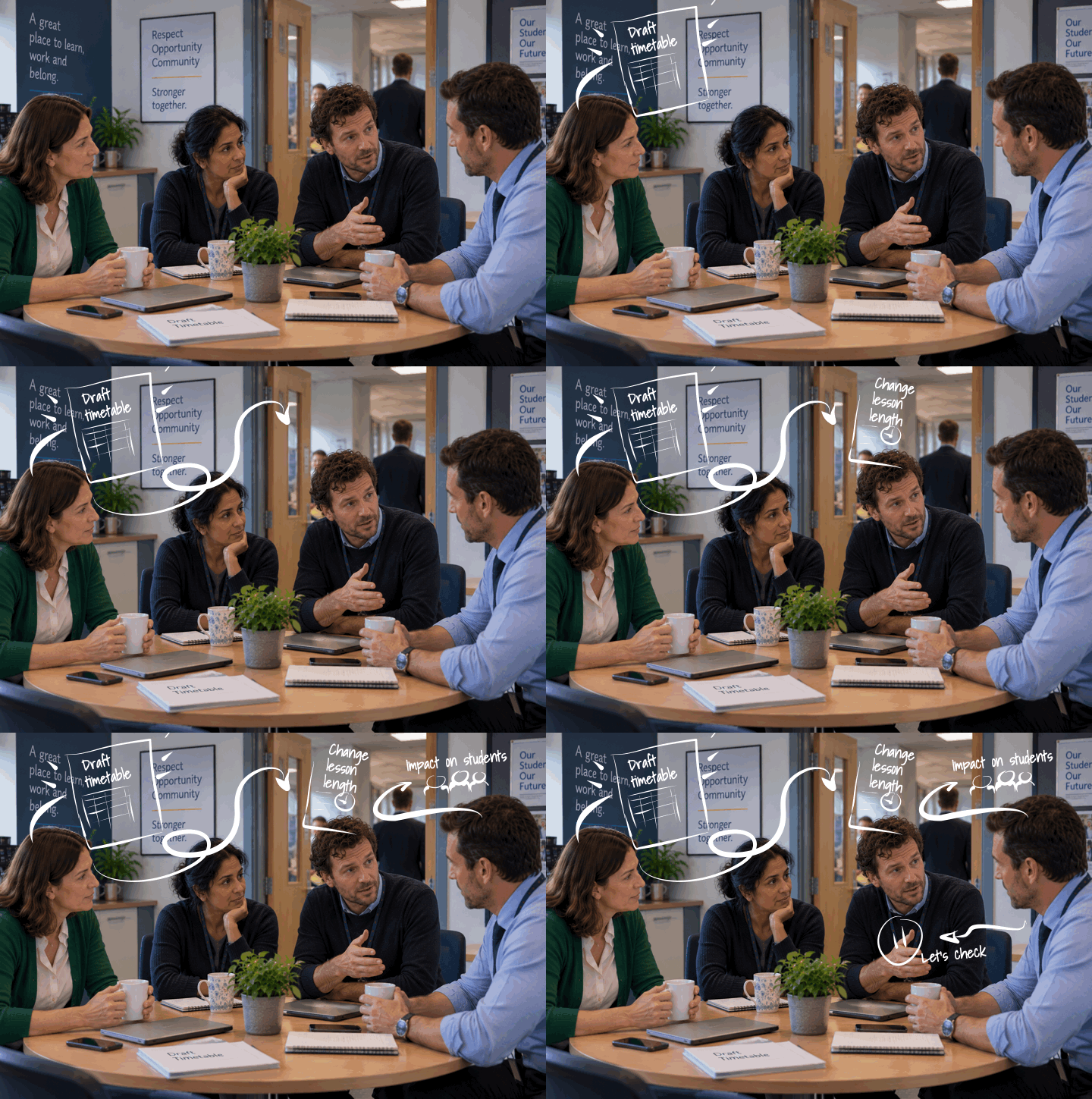
As he approached the open door, he heard Mark.
“So we’re not saying the timetable is changing?”
Sarah answered.
“No.”
A pause.
“Are we saying it isn’t?”
“No.”
Another pause.
James spoke.
“Can we say this is significantly less exciting than the version you came in with?”
“Yes.”
Martin stopped outside.
He could see the strategic plan through the doorway. Beyond it, Sarah was drawing something on a scrap of paper. Mark was talking.
Priya interrupted him.
James challenged something she said. Nobody lowered their voice. Nobody noticed Martin.
He reached towards the door. Then stopped.
His phone could wait. He continued down the corridor. Behind him, the conversation carried on.