Collective Thinking Design: See
Mission Impossible
Most workshops tell you what to change.
This one teaches you to see what needs changing.
Part of the Waterline series → Waterline Lab · Designing the Waterline
Six carefully engineered encounters. No lectures. No frameworks presented up front. Instead, your team experiences - in real time - how hidden conditions shape behaviour more than personality, motivation, or ability.
By the end of the day, they're not carrying a new model - they're carrying a diagnostic lens they can use on Monday, underneath whatever improvement plan you're already running.
Format & audience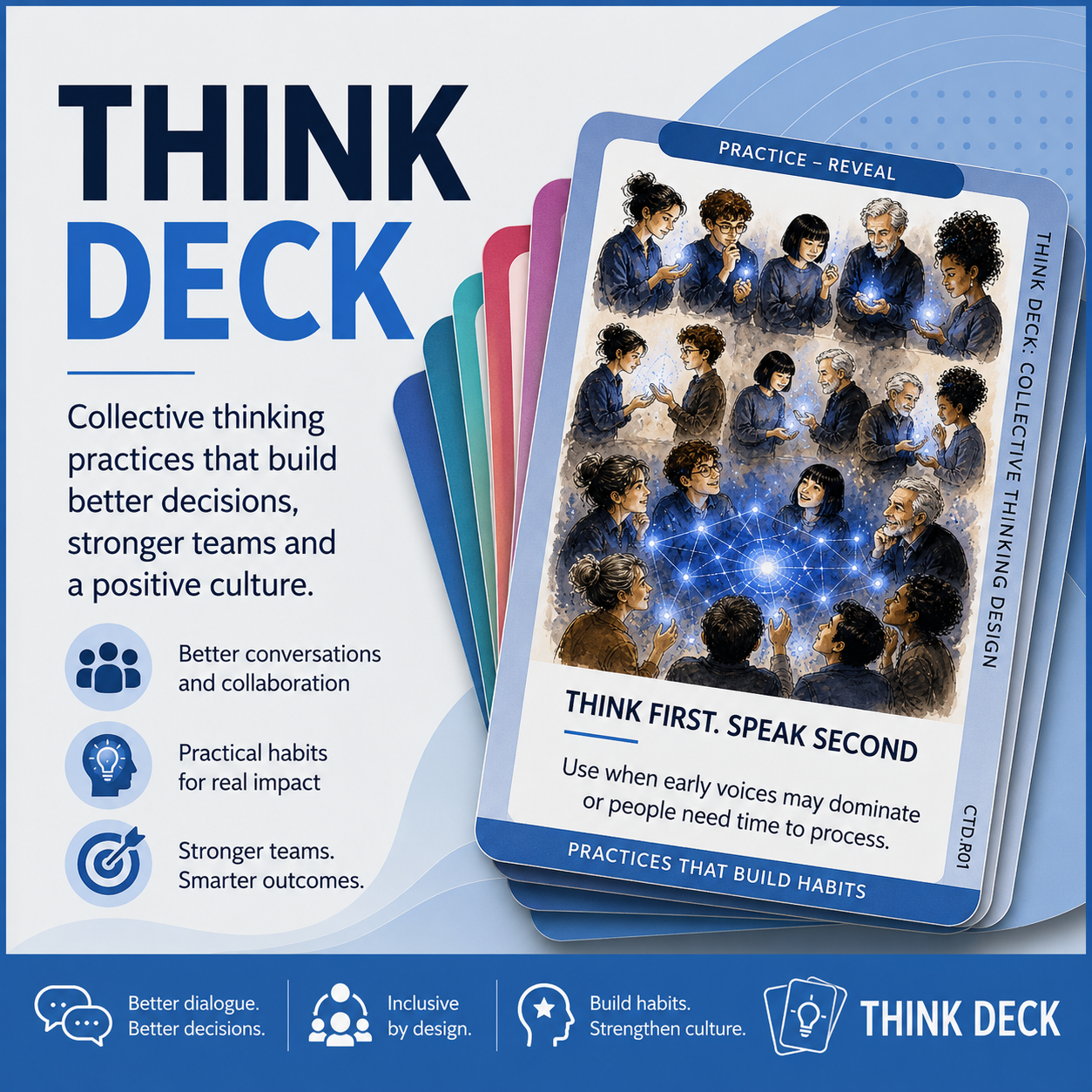
The physical system behind the workshop
The Think Deck behind the experience.
The six encounters help a team feel hidden organisational conditions in real time. The Think Deck gives the group a shared vocabulary for recognising those conditions again, and practical ways to change what happens in the conversations that follow.
This is the connection between the day and Monday: an experience becomes language, and language becomes something the group can use.
Explore the Think DeckExperience first. Framework second.
Six encounters. One operating system.
Each encounter reveals a different layer of the same hidden architecture - the conditions that shape behaviour before personality, motivation, or ability ever enter the equation. None of this replaces the improvement plan already on your desk. It's the layer underneath it - the part that decides whether the plan actually changes anything.
Friction
Where is attention being consumed by the design, not the task? The opening encounter reveals how hidden information - not ability - determines outcomes.
Permission
Who is quietly included - and who is quietly excluded? Participation is not personality. It is architecture. Discovered through a structured group task with a surprising reveal.
Signals
What would a completely rational person learn to do in this environment? People don't follow stated values. They follow the rules they infer from repeated experience.
Meaning
Are we agreeing - or just using the same words? Shared language is not shared meaning. Six people can agree on a priority while imagining six different realities.
Visibility
What matters that this system cannot currently see? Every dashboard has a waterline. The most powerful signals - trust, permission, belonging - are always below it.
Constraints
What behaviour is this environment making easy, safe, or rewarded? Culture isn't what people believe. It's the behaviour the system makes normal.
The diagnostic foundation
Every school has a waterline.
Above it: the metrics you report. Below it: the signals that shape culture, trust, and behaviour - invisible to most dashboards, absent from most meetings, yet more powerful than anything above the line.
Most iceberg slides belong to someone else's organisation - a teacher visited another school, or attended a conference, admired the tip of the iceberg, and brought back a photo. Call that a penguin: it travels between icebergs, but only ever sees the part above the water. Instead of sending penguins off to distant icebergs, let's plunge below the surface of your iceberg.

This encounter makes it visible in a way participants never forget - and gives your team a way to keep seeing it after the workshop ends.
The spine of the workshop
The Adaptation Chain
Every encounter reveals one link in this chain. By the end of the day, participants have felt it operate six times - in six different domains. They don't learn the chain. They recognise it.
The loop closes: culture becomes the new environment for the next person who walks in.
Where it fits
Not a standalone workshop. A diagnostic engine.
Beneath the Waterline shares DNA with the Synnovate diagnostic apps and the SVP institutional sensing framework inside Loom. Together they form a complete cycle.
Diagnose
The Culture Diagnostic and Board Diagnostic reveal operating patterns - not what people say they value, but what they actually do under pressure.
Run before the workshop to establish a baseline.
Experience
Beneath the Waterline turns diagnostic data into lived understanding. Six encounters teach your team to see the conditions producing their patterns - and to redesign them.
The centrepiece. Full-day.
Sustain
SVP - System Visibility Process - is Loom's structured method for logging recurring organisational patterns as trackable evidence, not anecdote. Over time it captures institutional signals, surfacing patterns, tensions, and coherence gaps before they become crises.
Ongoing visibility. The workshop primes teams to read SVP data correctly.
For leadership teams & staff
Format & audience
Beneath the Waterline is built for the people who operate the school's system day to day - senior leadership teams, middle leaders, and whole-school staff. The encounters use school-specific scenarios - staff meetings, classroom dynamics, parent communications, improvement planning - to reveal how environments shape behaviour at every level.
The workshop
Beneath the Waterline
A full day, all six encounters plus the Redesign Studio. Participants leave with a redesigned artefact - a meeting agenda, a policy, a routine - and the capacity to continue the work independently. The first step of the leadership & staff Waterline arc.
On the board?
Strategy by Design
Boards follow a different route. Rather than the full Waterline arc, boards use the same below-the-waterline lens to build strategy in full cognizance of the system they govern - diagnosing why the last strategy never quite happened, then rebuilding it as a coherence chain.
The thinking underneath What school culture looks like under pressure is the short version of the problem this workshop works on.
The six lenses in this workshop come out of The Hidden Ecology, an essay on why environments shape the people inside them. Designing What Matters sets out what decides where a school's attention actually goes.
The question isn't "what's wrong with the people?"
It's "what is this environment making easy, safe, rewarded - and what is it making hard, risky, or invisible?"
That question is the beginning of redesign. Beneath the Waterline teaches your team to ask it - and leaves them with something already redesigned, not just a new way of talking about the problem.
Enquire about a workshop