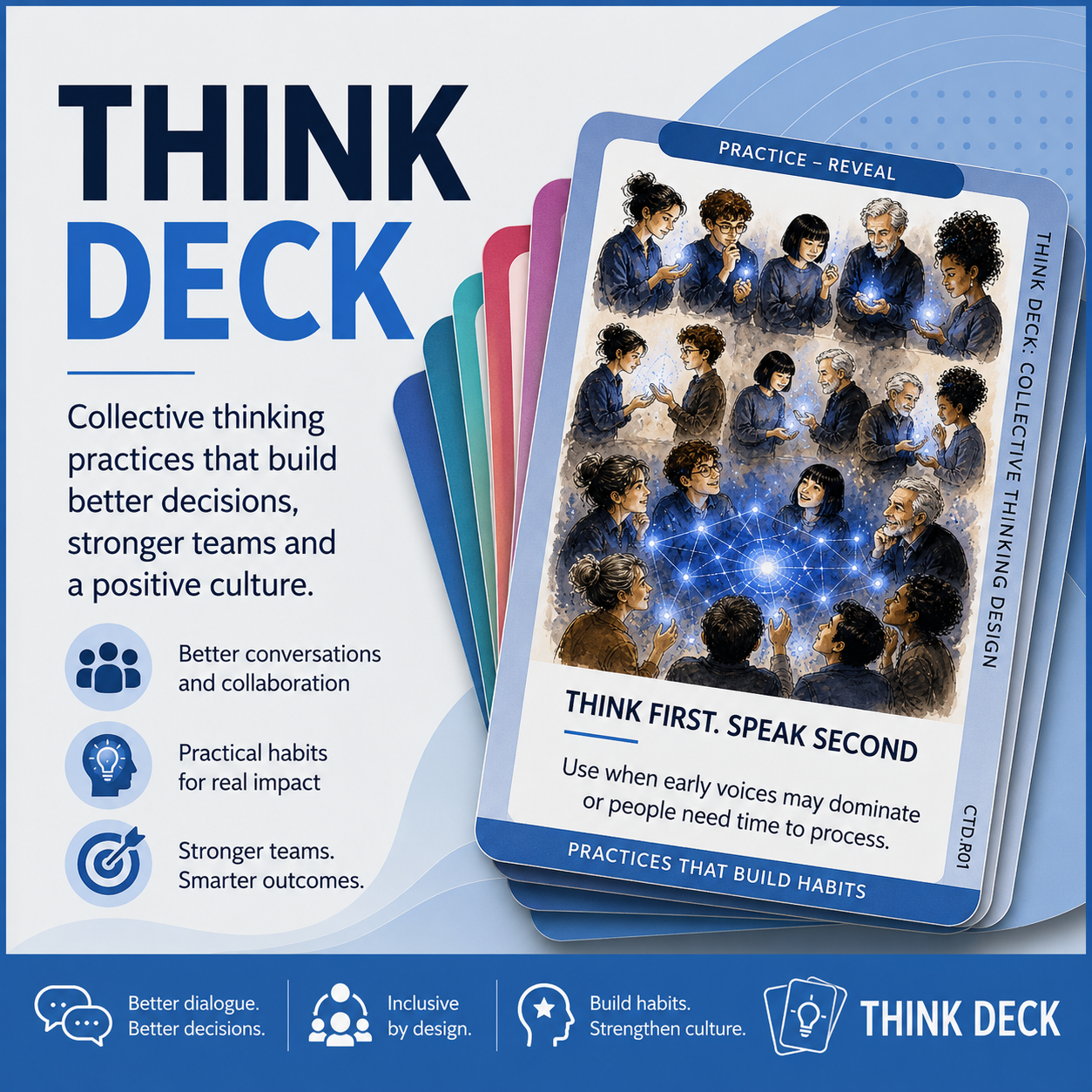
Think Deck

You Can't Bring Back New Eyes

Organisations change when they increase their capacity to think together.

Staff visit another school. A teacher attends a conference. A board spends a weekend on strategy.

Everyone comes back energised.

Very little changes.

Why?

For years I've watched capable educators return from exceptional professional learning full of ideas. They arrive with notebooks overflowing, photographs of slides, books under their arm, and the unmistakable enthusiasm of someone who has just experienced a genuine shift in thinking.

For a few days the conversations are animated.

Then school begins again. The coffee machine breaks. The Year 8 behaviour issue returns. Reports are due. Parents email.

Within a month the excitement has faded, and everyone quietly concludes that another promising idea has failed to take hold.

We usually explain this as a problem of implementation.

I wonder whether we're diagnosing the wrong problem.

That requires more than shared information. It requires shared ways of seeing.


Two kinds of professional development

Not all professional learning is the same.

Some development is technical. IB curriculum updates. Examination moderation. Safeguarding certification. New assessment software. One person attends because one person needs the expertise. Knowledge transfer works fine here.

Other professional learning is fundamentally different. Leadership. Culture. Assessment philosophy. Governance. Systems thinking. Collective efficacy.

These are not collections of information. They are new ways of seeing. And ways of seeing don't travel the way information does.

Knowledge can be emailed. Skills can be demonstrated. Perception usually has to be experienced.


The optical illusion

Think about one of those optical illusions where the image suddenly flips. At first you can't see it. Then, for a brief moment, it appears. It disappears again. Eventually you can switch between the two interpretations almost at will.

Nobody explained the second picture into existence. Your perception changed.

Many important professional ideas work like that. At some point they stop being concepts and become ways of seeing. Once you've experienced that shift, you find yourself noticing things that had always been there. You cannot quite return to your previous way of looking.

But there's a catch. The conference didn't just give you new information. It temporarily changed your perceptual system. Every keynote reinforced the same lens. Every coffee conversation continued the thinking. The environment itself became part of the learning - everything pointed in the same direction.

Then Monday arrives and the environment changes completely. The conference reinforced one way of seeing. School reinforces another. The new perceptual model now competes against years of existing organisational habits. The insight isn't fading because it's weak. The context that supported it has disappeared.


Then Monday arrives

Now imagine trying to share what you've seen. Your colleagues are still seeing the organisation through exactly the same lenses they had last week. You are trying to describe a picture that only you can currently see.

Not because they lack intelligence. Because they haven't experienced the perceptual shift that produced your conclusions.

We often say: "They just don't get it."

Perhaps a fairer description would be: "They haven't seen it yet."

This also explains something curious. People return from conferences saying "everything suddenly clicked." They aren't saying "I received more information." They're describing a perceptual reorganisation. That's why they struggle to explain - they're trying to describe a new way of seeing using the vocabulary of the old one.


This explains the penguin

I've often used the analogy of a penguin diving beneath the waterline. One penguin dives. It discovers where the fish are. It returns to the colony excited. The other penguins listen politely. But they haven't been underwater. The diving penguin can bring back fish. It cannot bring back the experience of seeing beneath the surface.

But I've come to think the metaphor is even richer than that. The real shift isn't that the penguin found fish. It's that the penguin learned to read the currents. That's fundamentally different. Fish represent visible outcomes - the notebook, the slides, the strategies. Reading currents represents a way of seeing - the ability to notice patterns, to sense what's below the surface, to navigate unfamiliar water yourself.

The penguin returns having developed a new lens. The colony is still looking at the surface. There is an enormous difference between telling someone where the fish are and helping them learn to read the currents for themselves.


Knowledge travels differently from perception

The research on professional learning has been remarkably consistent. Workshops alone rarely transform organisational practice. The conditions that make the difference - coaching, collaboration, sustained dialogue, collective participation - are well documented.

I think these are all pointing towards the same underlying mechanism. Knowledge can be transmitted. Skills can be demonstrated. Shared perception has to be constructed.

That cannot be emailed. It cannot be summarised in twenty PowerPoint slides. It emerges through repeated conversation around shared experiences, through common language, through looking at the same problem through the same lens at the same time.


Why shared perception matters

Shared perception isn't valuable simply because people agree. It's valuable because it changes where attention goes.

Every meeting begins with a finite amount of cognitive bandwidth. Some of that bandwidth is available for the work. Some is consumed by invisible social calculations. Can I ask this? Will I sound naïve? Am I reading the room correctly? Should I challenge the Head?

Every moment spent protecting ourselves is a moment unavailable for thinking.

That's why psychological safety matters. Not because it makes people happier. Because it releases attention.

Once attention is no longer divided between the problem and self-protection, something else becomes possible. Collective thinking.

The Think Deck, seen this way, doesn't merely create shared perception. It reduces the cognitive effort required to establish it. The card answers the social questions in advance - yes, you're allowed to look beneath the surface, yes, we're deliberately seeking a missing viewpoint, yes, it's safe to name what hasn't been said. That bandwidth, reclaimed, becomes available for the work itself.


Perhaps we've misunderstood professional development

When someone returns from a conference we often ask them to present what they learned. As if information were the scarce resource.

Perhaps the more useful question is: "How do we help everyone see what you have started to see?"

Those are completely different conversations. The first produces reports. The second develops shared mental models. The first assumes knowledge transfer is sufficient. The second recognises that perception has to be constructed together.


Why I built the Think Deck

This has made me think differently about the purpose of the Think Deck. Originally I thought of it as a collection of ideas, habits and practices. Increasingly I think it's something else. It's a shared cognitive vocabulary. Or perhaps more accurately - a collection of permission artefacts.

The cards don't simply explain ideas. They give groups permission to adopt a temporary way of thinking.

Think about aviation. If any member of the flight crew says "go around," nobody debates the phrase. Nobody asks for a presentation. Those two words invoke an entire agreed protocol. They temporarily change how everybody in the cockpit thinks and acts.

Medicine does the same thing. "SBAR." "Time out." "Code Blue." Engineering. "Red line." "Rollback." None of these work because they're clever. They work because they compress a shared understanding into a small, instantly recognisable token. Two syllables replace twenty minutes of negotiation.

Perhaps schools need something similar. Not for emergencies. For thinking.

Imagine placing a Waterline card in the middle of a leadership meeting. Nobody needs a lecture on systems thinking. The card simply says: "For the next few minutes, let's all adopt this lens." Or Perspective. Or Signal. Or Reveal.

The card is no longer information. It becomes permission. Permission to think together in a different way. The authority moves away from the individual - "trust me, I learned this at a conference" - and onto a shared protocol. The card removes the need for someone to negotiate permission every time. The protocol does that work in advance.


From explanation to shorthand

This connects to something much older. Human cultures have always compressed complex reasoning into remarkably small artefacts. "Measure twice, cut once." "The map is not the territory." "Strong opinions, loosely held."

A proverb compresses ten minutes of explanation into ten words. Not because the words are magical. Because the community has attached a shared way of seeing to them.

I think the Think Deck is attempting something similar - and there are really two phases to how it works. In the first phase, people learn. They read the cards. Discuss them. Use the practices. Build understanding together. The card is still an explanation.

In the second phase, something shifts. Nobody needs to read the card anymore. Someone simply says "Waterline." Or "Reveal." Or "Signal." The card has become organisational language. It's the difference between needing to explain first principles and simply invoking them.

This also solves the conference problem in a more practical way than sending more people. Instead of returning with twenty pages of notes, imagine the returning teacher saying: "The whole conference, for me, boiled down to one card." They place Perspective on the table. "Can we spend fifteen minutes looking at one issue through this lens?" Now they aren't reporting. They aren't persuading. They aren't the expert who went away and came back with answers nobody asked for. They're facilitating. The authority shifts from their expertise to a shared protocol. The card does the work that a thirty-minute presentation cannot do - it creates a temporary shared lens that everyone can look through, right now.


Organisations don't change because one person understands more than everyone else. They change because enough people begin looking at the same problem through the same lens.

Shared language makes that possible. Shared perception makes it sustainable.

And when less cognitive bandwidth is spent navigating the conversation, more becomes available for improving the system itself.

Perhaps that is the real purpose of professional learning. Not to return with better answers. But to help organisations develop the capacity to think together.